Wedding Relatives Interrogation Circuit
November 2, 2026 · 9 min read · by Shivam Kushwaha, Artha founder
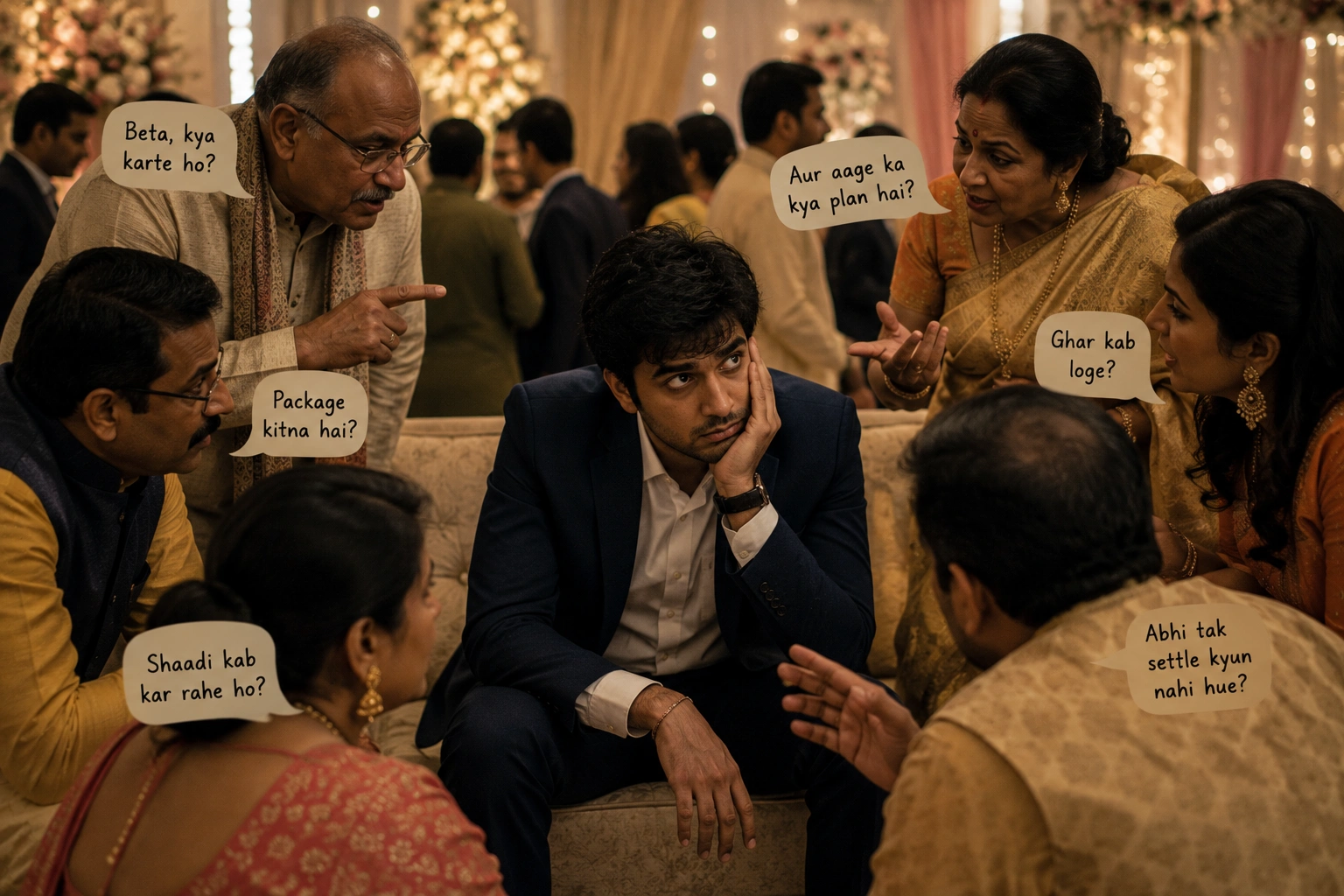
You've been at this wedding for exactly forty minutes and you've already fielded the question four times, from four different aunties, in four slightly different phrasings, "so when's your turn," "you're next now," "don't take too long, beta." Each one delivered with a smile, like it's a compliment, like it's not the fifth time tonight someone's reduced your entire life to a single unanswered timeline question you didn't come here to discuss.
Why Weddings Turn Into an Interrogation Circuit
Here's the honest truth about the wedding relatives interrogation circuit: it isn't really personal curiosity, even though it lands that way every single time. Weddings put marriage at the center of everyone's attention for an entire evening, which makes it the obvious, default small talk topic for every relative in the room, and if you happen to be single or unmarried, you become the natural next subject the moment the actual couple's story runs out of things to discuss.
There's a specific reason this particular kind of unsolicited attention feels so grating, even from relatives who genuinely mean well. Psychological reactance theory describes what happens when people feel their autonomy or freedom is being pressed on, even through advice or questions that come from a good place, it triggers a defensive, negative response and a strong pull to reassert control over the thing being pressured, whether that's rejecting the advice outright or simply resenting the person delivering it (an overview of psychological reactance theory and its origins in Jack Brehm's research). That's exactly why "you're next" from a fourth relative in one evening feels so much worse than the same comment said once, kindly, by someone you're actually close to. It's not really about the words, it's about how repeatedly being nudged toward a timeline you didn't choose starts to feel like a loss of control over your own narrative, even when nobody in the room intends it that way.
There's also a specific compounding effect that happens at weddings specifically, because the same question gets asked by relatives who don't coordinate with each other and have no idea how many times you've already answered it that same evening. Each individual aunty asking feels, to her, like a single friendly comment. To you, it's the sixth identical conversation of the night, and that mismatch, one relative's isolated question landing inside your much longer, cumulative evening, is a huge part of why the fatigue builds so fast.
If you're also managing a career gap or an unconventional path that draws its own round of questions, the marriage question often gets asked in the very same breath, one relative covering both your career and your relationship status in a single conversation, as though the two are simply two boxes on the same checklist they're quietly running through with you.
The Specific Shape This Pressure Takes
A lot of this pressure carries an implicit, if rarely spoken, subtext about running out of time, framed around age, around how "good matches get taken," around a vague sense of urgency that has little to do with your actual readiness or circumstances and a lot to do with an inherited cultural timeline most relatives are simply repeating without much reflection. That urgency rarely accounts for what's actually happening in your life, a career you're still building, a relationship you're taking your time with, simply not being ready yet, none of which registers as a valid answer inside the framing the question usually comes wrapped in.
There's also a specific version of this that gets worse if you've already been through a rejection or two in the process, whether an arranged match that didn't work out or a relationship that ended. Relatives who know about that history sometimes bring it up at exactly the moment you'd least want it revisited, treating a genuinely painful chapter as casual wedding small talk, without realizing, or perhaps without caring, how much weight that specific memory still carries for you.
The advice that tends to follow the question is its own particular strain too, unsolicited suggestions about matchmaking apps, about a "perfect boy or girl" someone happens to know, about what you're supposedly doing wrong in your search, delivered with total confidence by people who often know very little about your actual life or preferences. That advice rarely lands as helpful, mostly because it wasn't asked for and doesn't account for anything specific about your situation beyond the fact that you're currently unmarried.
There's a particular version of this that shows up if you've already gone through the arranged marriage process and faced a rejection along the way, since relatives who know about it sometimes treat it as an open invitation to theorize, out loud, about what might have gone wrong, your career, your appearance, your expectations, none of it asked for, all of it delivered as though diagnosing the issue is a favor rather than an intrusion. If that specific rejection is already something you're carrying quietly, having it revisited casually at a wedding, by someone who wasn't even part of that process, adds an extra layer of exposure to something that was already hard enough to sit with privately.
There's also a specific escalation that tends to happen as the evening goes on and alcohol, if it's that kind of function, or simply comfort levels loosen up further. Questions that started fairly gentle in the early hours of a wedding sometimes turn more pointed later on, more direct comparisons to a sibling or cousin who's already married, more explicit commentary about age or timing that wouldn't have been said as bluntly earlier in the evening. Knowing that pattern in advance, that the later hours tend to bring less filtered versions of the same question, can help you pace your own energy and know roughly when to expect the harder conversations to land.
What Actually Helps
The most useful preparation is having a short, warm, closing response ready in advance, something like "when it happens, it happens, I'm not stressed about it" delivered lightly enough to close the topic without turning it into a visible confrontation. A response that sounds settled and unbothered tends to end the conversation faster than one that sounds defensive, mostly because it gives the relative nothing to push against or elaborate on further.
It also helps to have a redirect ready, genuinely asking about their own family, their kids, anything that shifts attention away from you specifically. Most people are glad to talk about themselves once given the opening, and redirecting the spotlight tends to work better than trying to out-argue a question that was never really a genuine inquiry to begin with.
It's worth deciding in advance which relatives are worth a more direct conversation and which ones are better handled with a light deflection you don't take too seriously. A parent or a very close relative who keeps raising it might be worth an honest, private conversation outside the noise of a wedding, "I know you're not trying to pressure me, but hearing it repeatedly at every function is genuinely wearing." A distant relative you see once a year probably doesn't need that same investment, a smooth, practiced deflection usually does the job just fine there.
It also helps enormously to go into these events with at least one ally already briefed, a sibling, a cousin, a friend, who can step in with a subject change or a well-timed interruption when a conversation starts heading somewhere you'd rather not go. Having even one person in on the plan turns the whole evening from something you're bracing for alone into something you're actually navigating together.
It's worth pacing yourself across the wedding season as a whole, too, not just any single event. If this is one of several weddings on your calendar this month, treating each one as its own isolated evening, rather than one continuous, cumulative gauntlet, helps prevent the exhaustion from one function bleeding into your dread for the next. Building in genuine recovery time between events, even something as simple as a quiet evening at home the day after, keeps the fatigue from compounding across the whole season.
It also helps to remember that your parents, if they're present, are often fielding a version of this same pressure directed at them, questions from their own siblings and friends about when you'll be settled, sometimes even more pointed than what gets said to you directly. Recognizing that they might be absorbing their own share of this same interrogation can make the family dynamic feel less like everyone ganging up on you and more like a shared, if unevenly distributed, discomfort that the whole immediate family is navigating together, each in their own way.
Where Artha Fits, If It Does
A lot of what makes this circuit so exhausting is that it repeats, function after function, season after season, with no real end point in sight until your own life happens to change in the specific way everyone's been asking about. That's part of why Just Talk Shop exists inside Artha, a place to say "I got asked four times tonight and I still have two more weddings this month" to someone anonymous who genuinely understands how draining that specific, repeated question actually is, without turning the conversation into more advice about your timeline.
Your relationship status, whatever it currently is, isn't something you owe an explanation for at every family function you attend. The people asking will mostly forget the exchange by the next course. You're allowed to walk out of that hall exactly as unbothered as you'd like to be, whatever the room's collective curiosity might suggest you should feel instead.
There's also something worth naming plainly, that a lot of the anxiety around this circuit builds well before the wedding even starts, the anticipation of the questions sometimes weighing heavier than the actual conversations end up being once you're there. Most individual exchanges last less than a minute before the relative moves on to the next topic or the next guest, and remembering that in the days leading up to an event can take some of the dread out of the anticipation itself, even if it doesn't remove the discomfort entirely once you're actually standing in the hall.
If you didn't have to manage anyone else's expectations about your timeline tonight, what would you actually want your honest answer to that question to sound like?
Quick answers
Things people usually want to know.
Why do relatives always ask about marriage at every single wedding?
Weddings put marriage at the center of everyone's attention for the evening, making it the default small talk topic, and if you're single, you naturally become the next subject once the actual couple's story runs out of things to discuss.
Why does being asked "when's your turn" repeatedly feel worse than hearing it once?
Psychological reactance theory explains that when people feel their autonomy is being pressed on, even through well-meant questions, it triggers a defensive response and a pull to reassert control, which builds fast when the same question repeats all evening.
Do relatives realize how many times they're collectively asking the same marriage question?
Usually not. Each relative asking feels, to them, like one friendly comment, with no idea it's the sixth identical conversation you've had that same evening, which is part of why the fatigue builds so quickly on your end.
What's a good response when relatives keep asking about my marriage timeline?
Have a short, warm closing line ready, something like "when it happens, it happens, I'm not stressed about it." A response that sounds settled tends to end the conversation faster than one that sounds defensive.
How do I handle unsolicited matchmaking advice from relatives?
It rarely lands as helpful since it wasn't asked for and doesn't account for your actual preferences. A light redirect, asking about their own life instead, usually works better than trying to argue with advice you never wanted.
Should I have a direct conversation with a relative who keeps pushing about marriage?
For a close relative who repeats it often, yes, a private, honest conversation outside the noise of an event tends to help more than a deflection. A distant relative you see once a year probably doesn't need that same effort.
Why do marriage questions get more pointed later in a wedding function?
As the evening goes on and comfort levels loosen, questions that started gentle sometimes turn more direct, more explicit comparisons or blunter commentary about timing than would've been said earlier.
Is it helpful to bring someone to a wedding to help deflect marriage questions?
Yes, having an ally briefed in advance, a sibling or friend who can step in with a subject change, turns the evening from something you're bracing for alone into something you're navigating together.
How do I manage marriage-question fatigue across a whole wedding season?
Treat each event as its own isolated evening rather than one continuous gauntlet, and build in real recovery time between functions so the exhaustion from one doesn't bleed into dread for the next.
Do my parents face the same marriage-pressure questions I do?
Often, yes, sometimes more pointedly, from their own siblings and friends. Recognizing that can make the family dynamic feel less like everyone ganging up on you and more like a shared discomfort the whole family navigates.