Arranged Marriage Rejection and Your Self-Worth
October 8, 2026 · 9 min read · by Shivam Kushwaha, Artha founder
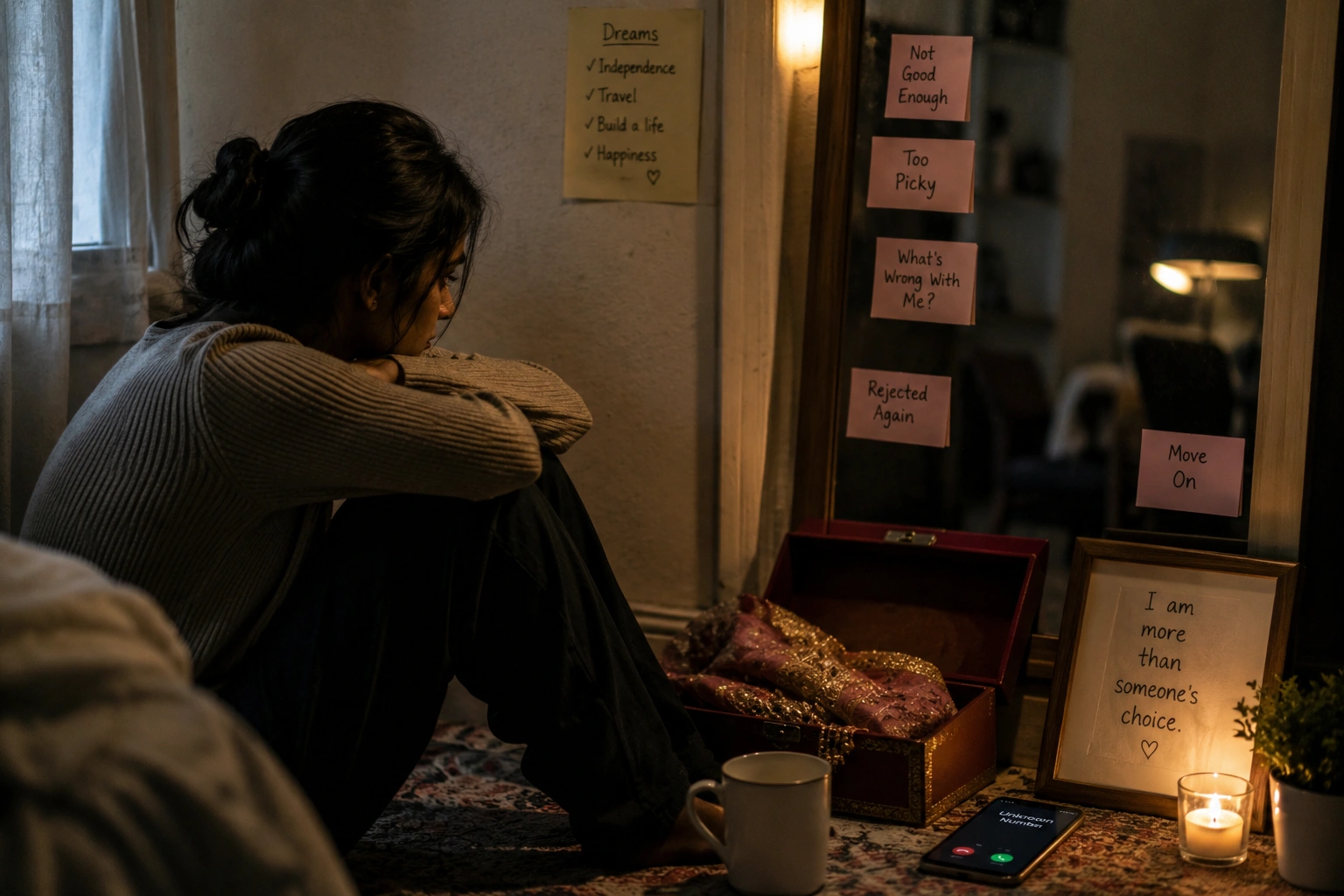
The message from the relative comes through around 9pm, the way these things usually do, phrased carefully, softened with three "actually"s before it gets to the point. "They said the horoscope didn't match" or "they're looking at someone with a government job" or, worse, no reason at all, just a quiet no that travels back through two aunties and a family WhatsApp group before it finally reaches you. You read it twice. Then you put the phone face down and sit there for a while, trying to figure out why a stranger's opinion of your biodata feels like it just said something true about you.
Why an Arranged Marriage Rejection Cuts So Deep
Here's the honest truth about arranged marriage rejection: it's rarely processed as a simple mismatch, even though that's usually all it technically is. It gets processed as a verdict, because of how the entire system is set up, your education, your job, your family background, your appearance, all condensed onto a single biodata page and evaluated, often within minutes, by people who've never actually met you. That format alone makes rejection feel less like "we weren't compatible" and more like "you, as summarized on paper, weren't enough."
This isn't just an emotional overreaction, there's real psychology behind why it lands this hard. Leary's sociometer theory, a well-established framework in social psychology, holds that self-esteem functions as an internal gauge of how accepted or valued we are by others, cues that signal rejection or devaluation genuinely lower self-esteem, because the system evolved specifically to alert us when our social standing is under threat (an overview of Leary's sociometer theory). An arranged marriage rejection is about as direct a devaluation cue as it gets, a formal, documented "not chosen," which is exactly the kind of signal that theory predicts would hit self-esteem hard, regardless of how rationally you understand the actual reasons behind it.
There's also a specific layer of exposure that comes from how public the process usually is within a family. Unlike a rejection in a private dating context, an arranged marriage rejection often gets discussed among relatives who already know it happened, sometimes before you've even fully processed it yourself, which means there's no quiet, private space to feel disappointed before the commentary starts, the well-meaning suggestions, the theories about what went wrong, the subtle implication that something about you needs adjusting before the next match comes along.
If you're already dealing with relatives asking pointed questions about your marriage timeline at every gathering, a rejection adds fresh material to that ongoing scrutiny, another data point relatives feel entitled to discuss, theorize about, and occasionally offer unsolicited advice on, whether you actually want to hear it or not.
What Repeated Rejection Does Over Time
A single rejection is hard enough to sit with. What tends to do the deeper damage is the accumulation, biodata after biodata, meeting after meeting, each one a fresh chance to be measured and found wanting in some specific, never-quite-explained way. That repetition has a way of teaching a lesson that isn't actually true, that you're fundamentally deficient somehow, rather than simply not yet matched with someone whose specific preferences happen to align with yours.
This gets worse when the reasons given, when they're given at all, feel arbitrary or contradictory across different rejections, told you're "too career-focused" by one family and "not ambitious enough" by another, in the same month. That inconsistency should logically prove the rejections say more about individual, specific preferences than about any objective truth regarding your worth, but in practice it often does the opposite, it starts to feel like there's some deeper, unnamed flaw that keeps surfacing in different disguises each time, since surely you can't be too much of two opposite things simultaneously unless something more fundamental is actually the problem.
There's also a specific kind of fatigue that builds from constantly performing an edited, market-ready version of yourself for each new introduction, the practiced answers, the careful framing of your job and your plans, the small adjustments made based on what worked or didn't in the last round. Doing that repeatedly, for match after match, takes a real toll that has very little to do with romance and a lot to do with a prolonged, formal evaluation process most people your age aren't going through in any other part of their life.
If comparing your own timeline against classmates who seem to be pairing off effortlessly is already a source of quiet dread, each rejection sharpens that comparison further, another data point suggesting everyone else's process is smoother than yours, even though what actually gets shared publicly, engagements, weddings, is never the full story of how many quiet nos came before it.
The Family Layer That Makes It Harder
Parents and relatives, however well-intentioned, often respond to a rejection by immediately shifting into problem-solving mode, more classes, a different photographer for your profile picture, a suggestion to "lose a little weight before the next meeting." Each suggestion comes from love and genuine worry, but landing right after a rejection, it can feel less like support and more like confirmation that something about you does need fixing, even when nobody in the room actually believes that consciously.
There's also the specific discomfort of watching your own parents absorb some of the disappointment too, sometimes more visibly than you do, which can leave you managing their emotional reaction on top of your own, reassuring them that you're fine, that the next one will work out, even in moments when you're the one who actually needs that reassurance yourself. That role reversal, comforting the people who are supposed to be comforting you, is a strange and rarely acknowledged part of how this process actually plays out inside most families.
This gets more complicated still when the extended family gets involved in ways that go beyond your immediate parents, an aunt who insists on being kept in the loop, a grandparent who brings it up unprompted at every gathering, a family friend who somehow knows about the rejection before you've told most of your own siblings. The arranged marriage process rarely stays contained to the two people actually being matched, and that wider circle of involvement means a single rejection can end up being discussed, dissected, and theorized about by more people than you'd ever choose to bring into a moment this personal, if the choice were actually yours to make.
It's also worth naming a quieter feeling that shows up for a lot of people going through this, a growing uncertainty about whether the process itself even reflects who you actually are anymore, or whether you've started subtly editing your answers, your stated preferences, even your sense of what you're looking for, to try to be more "matchable" after enough rounds of rejection. That drift is worth noticing early, because a version of yourself optimized to be accepted by the process isn't necessarily the version that ends up actually happy in whatever comes out of it.
What Actually Helps
The most useful shift is separating the rejection from any conclusion about your actual worth, as a deliberate, repeated practice rather than a one-time realization you're supposed to just arrive at and keep. A specific family's specific preferences not aligning with your specific profile is information about compatibility and circumstance, not a verdict on who you are, and it genuinely helps to say that to yourself plainly, even mechanically, every time a new one comes through, until it starts to actually feel true rather than just technically correct.
It also helps to find at least one person, a friend, a sibling, someone outside the marriage process entirely, who can hear about a rejection without immediately jumping into either sympathy that feels performative or advice about what to change next time. Sometimes what actually helps most is just being able to say "that one stung" out loud to someone who isn't also quietly evaluating your matchmaking strategy while they listen.
It's worth being honest with your family, gently but directly, about which kinds of post-rejection support actually help you versus which ones add pressure, whether that's asking for a few days before discussing the next match, or asking relatives to stop relaying detailed reasons that were never confirmed as accurate in the first place. Most families will adjust if you're specific about what you need, even if the initial conversation feels a little uncomfortable to start.
It's also worth deciding, deliberately, how much of your own sense of self-worth you're willing to let this specific process measure. The arranged marriage system is one particular, formalized way of finding a partner, with its own biases and blind spots, not an objective or complete assessment of your value as a person, and treating it as anything more than that hands it more power over how you see yourself than it actually deserves.
If relatives have also started treating your salary and your marriage prospects as one running conversation, asking about both in the same breath, it's worth remembering that a rejection doesn't reset your actual worth or timeline in any meaningful way, whatever the family gossip mill might quietly imply. Your life is still your own, shaped by circumstances that have very little to do with how quickly a match happens to come through, no matter how loudly the surrounding commentary suggests otherwise.
Where Artha Fits, If It Does
A lot of what makes these rejections so hard to sit with is that there's rarely a good, low-stakes place to actually process one, friends might not fully understand the specific weight of the system, and family is often too close to the process itself to hear it without immediately trying to fix something. That's part of why Just Talk Shop exists inside Artha, a place to say "I got rejected again and I don't even know what to feel about it anymore" to someone anonymous who understands the specific, layered weight this particular kind of no carries, without turning the conversation into another round of advice about what to change before the next match.
Being rejected by one family, or five, doesn't say what it feels like it says in the moment. It says a specific match didn't line up, nothing more precise than that, however carefully worded the reason back to you might have sounded.
If you set the biodata and the whole comparison game aside for a moment, what do you actually believe about your own worth, separate from anyone else's opinion of a page meant to summarize you in a few careful lines?
Quick answers
Things people usually want to know.
Why does an arranged marriage rejection hurt so much more than it seems like it should?
Because the biodata process condenses your entire life onto one page, evaluated by strangers, which makes rejection feel less like a mismatch and more like a verdict, that you, as summarized on paper, weren't enough.
Is there real psychology behind why rejection affects self-esteem this much?
Yes, sociometer theory holds that self-esteem functions as an internal gauge of how accepted we are by others, and cues signaling rejection genuinely lower self-esteem because the system evolved to alert us to threats in our social standing.
Why do repeated arranged marriage rejections feel worse over time?
The accumulation teaches a lesson that isn't actually true, that you're fundamentally deficient, rather than simply not yet matched with someone whose preferences align with yours. Each rejection adds to a pattern that starts to feel like proof of something it isn't.
Why do rejection reasons feel contradictory across different families?
Being called "too career-focused" by one family and "not ambitious enough" by another in the same month should logically show the rejections are about individual preferences, not an objective truth about you, even though it often feels like the opposite in the moment.
How should I respond when my parents want to immediately fix things after a rejection?
It helps to gently tell them what kind of support actually helps versus what adds pressure, whether that's asking for a few days before discussing the next match or asking relatives to stop relaying unconfirmed reasons.
Does an arranged marriage rejection say anything real about my worth?
No. A specific family's preferences not aligning with your profile is information about compatibility and circumstance, not a verdict on who you are, even though it genuinely helps to repeat that to yourself until it starts to feel true.
How do I stop editing myself to be more "matchable" after rejections?
Notice the drift early. A version of yourself optimized to be accepted by the process isn't necessarily the version that ends up genuinely happy in whatever relationship comes out of it.
Why does it feel like the whole family gets involved after a rejection?
The arranged marriage process rarely stays contained to the two people being matched, an aunt, a grandparent, a family friend can end up discussing and theorizing about a single rejection more widely than you'd ever choose.
How do I talk to someone about a rejection without getting more advice I didn't ask for?
Find at least one person who can hear "that one stung" without immediately jumping into sympathy that feels performative or advice about what to change next time.
How much power should the arranged marriage process have over my self-worth?
As little as you can manage. It's one particular, formalized way of finding a partner with its own biases and blind spots, not a complete or objective assessment of your value as a person.