Trader's Profitable Year Dread: When Winning Feels Off
October 29, 2026 · 9 min read · by Shivam Kushwaha, Artha founder
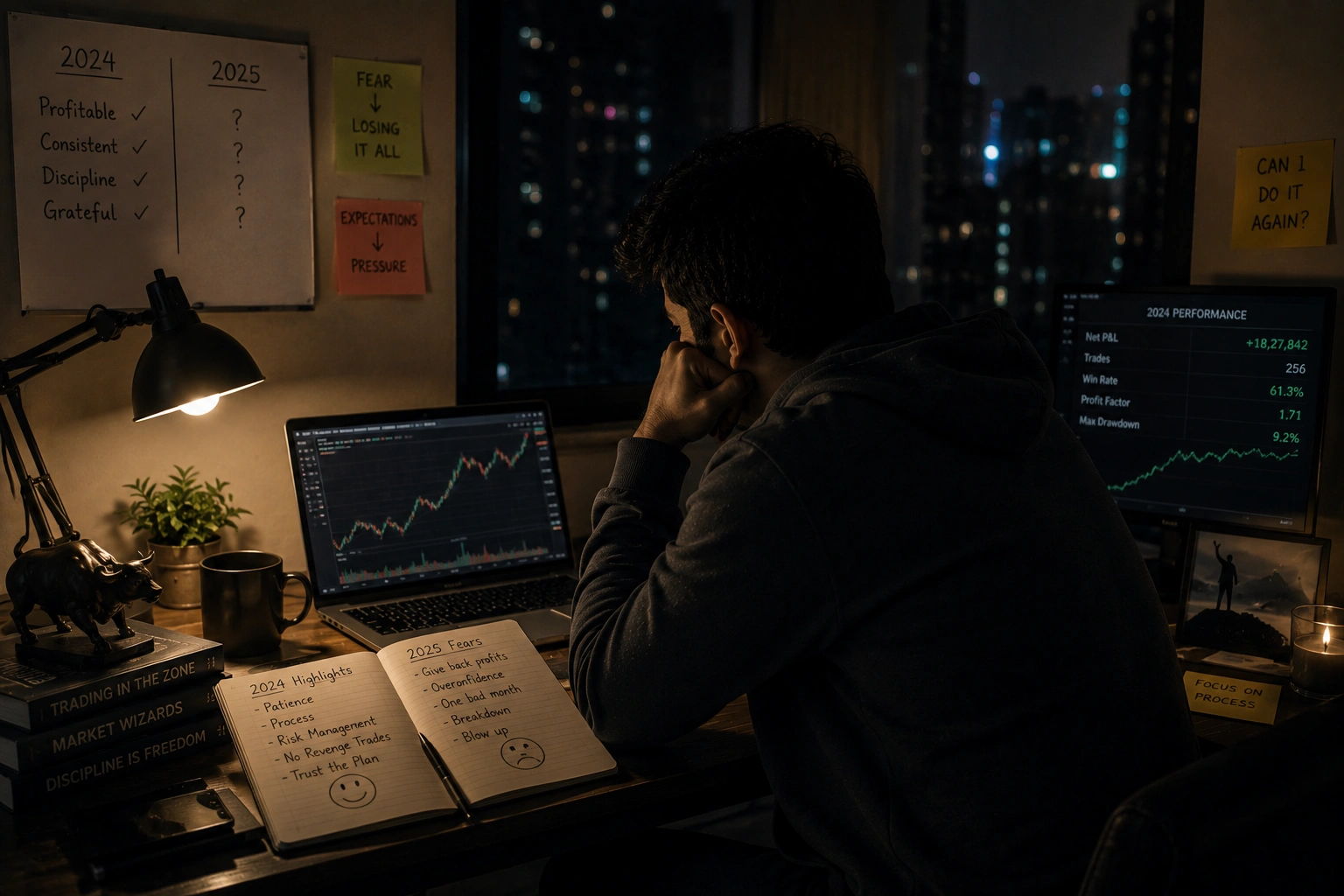
Your portfolio's up thirty-one percent this year. By any reasonable measure, that's a genuinely good outcome, better than most mutual funds managed, better than most of your friends' fixed deposits, better than you honestly expected when you started the year. And yet here you are, on the last trading day of December, closing your terminal with a strange, heavy feeling in your chest that has nothing to do with excitement. If anything, it feels closer to dread. Next year has to top this. And some part of you is already convinced it won't.
Why a Winning Year Can Feel Like a Threat
Here's the honest truth about profitable-year dread: it's rarely about gratitude or its absence. Most traders who feel this specific unease know, intellectually, that this year went well. What they're actually afraid of is regression, the very real, very common pattern where an unusually strong year gets followed by a much more ordinary one, and the fear that the gap between this year's number and next year's will somehow feel like failure, even if next year is still perfectly respectable on its own terms.
This dread gets sharper the more publicly you've celebrated the win. If you've told friends, posted a subtle screenshot, mentioned the number to family at some point this year, the pressure to repeat or exceed it isn't just internal anymore, it's attached to an audience who's now, whether they intend to or not, watching for next year's result too. A private win carries private stakes. A win that's been shared carries social stakes, and social stakes are considerably harder to shake off at 2am when you're staring at the ceiling wondering if this year was a fluke.
There's also a specific, uncomfortable honesty a lot of profitable traders reach eventually, that a meaningful chunk of this year's gain came from conditions outside their control, a broader bull run, a sector tailwind, timing that worked out more than skill that was earned. That awareness, when it's genuinely accurate, produces a kind of imposter feeling that sits uneasily next to an objectively strong result, you know you made real decisions, but you also suspect the market did more of the heavy lifting than your ego wants to admit.
Family and friends unintentionally add to this pressure too, once they know the number. A relative mentioning it at a gathering, a friend half-jokingly asking for stock tips now that you've "figured it out," these moments feel like compliments, and they mostly are, but they also quietly cement an expectation that this performance is now simply who you are as a trader, an expectation that has very little to do with how markets, or even skilled traders, actually perform over a longer stretch of time.
What's Actually Happening Psychologically
A lot of this dread traces back to a well-established statistical pattern called regression to the mean, extreme results, in either direction, tend to be followed by results closer to the average over time, purely as a property of how variable outcomes behave, independent of whether the underlying skill or strategy actually changed at all (Forbes' explainer on applying regression to the mean to investment performance). If this year sat well above your normal average performance, some pullback toward that average next year isn't a sign anything's gone wrong, it's closer to the expected, ordinary behavior of returns over a longer horizon.
Knowing that intellectually rarely stops the dread from showing up anyway, though, because the fear isn't really statistical, it's identity-based. Somewhere over the course of this profitable year, "trader who has a great year" quietly became part of how you see yourself, and the prospect of a more ordinary year ahead feels less like normal variance and more like losing something you've come to think of as who you are, rather than something you did, once, under a specific set of favorable conditions.
There's also a strange kind of grief that shows up around a winning year that a lot of traders never expect and rarely admit to, missing the sharper, more alert version of yourself that a genuinely engaged, high-stakes year produced. A calmer, more ordinary next year might actually be the healthier outcome for your portfolio and your nervous system both, but it can still feel, in the moment, like a letdown after a year that had real intensity to it.
This is closely related to something a lot of successful traders describe once the adrenaline of a big year fades, a kind of anticlimax that arrives right alongside the achievement itself. You hit the number you'd been chasing, and instead of pure satisfaction, there's an odd flatness underneath it, along with the immediate question of what comes next, before you've even had time to actually sit with what just happened.
The Pressure to Perform Again
If you're already dealing with the strange guilt that sometimes follows trading profit, a winning year adds a second, compounding layer to sit with, not just discomfort about having profited while others around you struggled, but now also the added weight of feeling obligated to replicate that exact outcome, as if this year set a new baseline you're now required to meet indefinitely.
This pressure often shows up as a subtle but real shift in risk appetite heading into the new year, an unconscious pull toward bigger positions or more frequent trades, not because the setups genuinely warrant it, but because some part of you is trying to force a repeat performance through sheer increased activity. That's a genuinely dangerous instinct, since it's driven by last year's emotional residue rather than this year's actual market conditions, which are, by definition, always somewhat different from the ones that produced the prior result. It's worth watching your position sizing closely in January specifically, that's usually where this kind of quiet overcorrection shows up first, well before it's obvious in your overall results.
There's also a specific comparison trap that shows up here, watching other traders in your circle post their own year-end numbers and instinctively measuring your own next year's performance against theirs, rather than against your own realistic, personal baseline. That external benchmark rarely accounts for differing risk tolerance, differing capital, or differing life circumstances, and chasing it tends to push traders toward exactly the kind of oversized risk that turns a genuinely good multi-year track record into a single catastrophic year.
If you already know obsessively checking prices is a pattern you fall into, a strong year tends to intensify it rather than ease it, ironically. You'd think a good result would bring some calm, but for a lot of traders it does the opposite, now there's something concrete worth protecting, and the anxious checking shifts from "did I lose money today" to "am I still on pace to justify last year's number," which is, if anything, a more relentless and less satisfiable version of the same compulsion.
What Actually Helps With This Specific Dread
The most useful mental shift is separating this year's specific number from your identity as a trader entirely. You are not "someone who returns thirty-one percent a year." You're someone who made a series of decisions under a specific set of market conditions that happened to produce that outcome this time. Holding the number more loosely, as one data point in a much longer track record rather than a new permanent standard, takes a surprising amount of pressure off the year ahead.
It also helps to write down, honestly, how much of this year's result you'd attribute to skill versus conditions you didn't control. That's an uncomfortable exercise for a lot of traders, nobody loves admitting luck played a role in a number they're proud of, but an honest breakdown tends to lower next year's pressure considerably, because it reframes the goal from "repeat this exact number" to "keep making sound decisions, whatever the conditions turn out to be."
It's also worth deciding, deliberately, how much of this year's number you actually want to share going forward, and with whom. You don't owe anyone an ongoing public scoreboard just because you mentioned one good year once. Quietly scaling back how much of your trading performance becomes a topic of conversation, especially with people whose reactions add pressure rather than support, is a completely reasonable boundary to set for yourself heading into a new year.
Setting next year's goals based on your own process rather than last year's outcome tends to protect against the dread more effectively than any amount of positive thinking. A goal like "stick to my position sizing rules on ninety percent of trades" is something you can actually control. A goal like "beat thirty-one percent again" depends heavily on market conditions that have nothing to do with your discipline, and chasing it invites exactly the kind of oversized risk-taking that turns a strong multi-year record into a single bad year everyone remembers instead.
A useful reframe here is to think of this year's number less like a new floor you now have to defend, and more like proof of concept, evidence that your process can work well under the right conditions. That framing keeps the achievement fully real and fully yours, without quietly converting it into a debt the next twelve months now owe you.
Where Artha Fits, If It Does
A lot of what makes this dread hard to talk about is that admitting you're anxious after a winning year sounds almost ungrateful, complaining about a problem most traders would love to have. That's part of why Traders' Talk exists inside Artha, a place to say "I had a genuinely great year and I'm still dreading the next one" to someone anonymous who understands that a strong result doesn't automatically come with the peace of mind you'd expect it to.
A good year is worth acknowledging fully, on its own terms, without immediately converting it into pressure for the next one. Next year gets to be whatever it turns out to be, measured against your own realistic process, not against a number that was always going to be hard to repeat. This particular kind of dread has quiet company in the addictive pull trading itself can develop, the discomfort here usually says more about how you're relating to the outcome than about the outcome itself.
If this year hadn't gone so well, would you actually be dreading next year this much, or is the fear really about protecting something you're afraid of losing, a number, an identity, a version of yourself you only recently got to meet?
Quick answers
Things people usually want to know.
Why do I feel dread instead of pride after a genuinely great trading year?
It's rarely about lacking gratitude. Most traders who feel this know the year went well, what they're actually afraid of is regression, the very real pattern where an unusually strong year gets followed by a more ordinary one that feels like failure by comparison.
What is regression to the mean and how does it apply to trading?
It's a statistical pattern where extreme results, in either direction, tend to be followed by results closer to average over time, independent of whether your underlying skill actually changed. A pullback after an unusually strong year isn't a sign something's gone wrong.
Is it normal to feel like a good trading year was mostly luck?
It's a common and often honest realization. A meaningful chunk of a strong year can come from conditions outside your control, like a broader bull run, and recognizing that isn't the same as dismissing the real decisions you also made.
Why do I feel pressure to repeat a big trading year?
Partly because sharing the number, with friends, family, online, attaches social stakes to next year's result that a private win never carries. There's also an internal pull to protect a number you've quietly made part of your identity.
Does a great trading year make me take bigger risks the next year?
It can, often unconsciously, a pull toward bigger positions or more frequent trades, not because the setups warrant it, but because part of you is trying to force a repeat performance through sheer activity. It's worth watching position sizing closely right after a strong year.
How do I stop comparing next year's trading results to this year's?
Set goals based on your own process rather than last year's outcome, something like sticking to your position sizing rules, rather than a number tied to conditions you don't control. That protects you from chasing outsized risk to repeat a specific figure.
Why does a big trading year sometimes feel anticlimactic?
Hitting a number you'd been chasing for a while can bring a strange flatness instead of pure satisfaction, along with an immediate pull toward what comes next, before you've actually had time to sit with what just happened.
Should I keep sharing my trading results with friends and family?
That's worth deciding deliberately. You don't owe anyone an ongoing scoreboard just because you mentioned one good year, and scaling back who you share results with is a reasonable boundary heading into a new year.
Is checking prices obsessively worse after a strong trading year?
For a lot of traders, yes, ironically. Instead of easing anxiety, a strong result gives you something concrete to protect, and the checking often shifts from worrying about losses to worrying about staying on pace to justify last year's number.
How do I hold onto a great trading year without it becoming pressure?
Try holding the number more loosely, as one data point in a longer track record rather than a new permanent standard. Think of it as proof of concept that your process can work well under the right conditions, not a floor you now have to defend.