Trading Addiction: When the Market Becomes Your Drug
September 7, 2026 · 7 min read · by Shivam Kushwaha, Artha founder
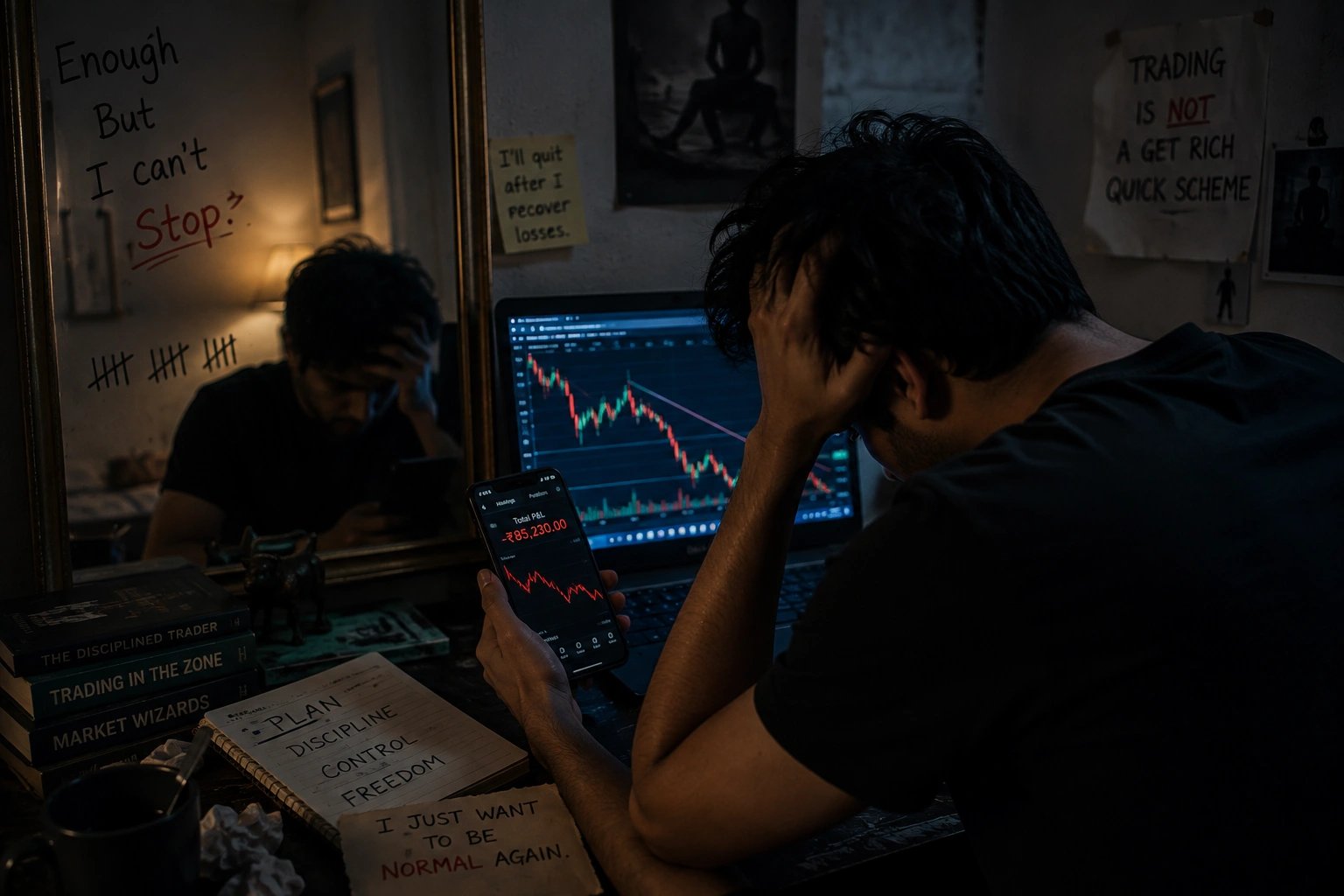
The High That Keeps You Coming Back
You know the feeling. You enter a trade. Your heart rate goes up. You watch the numbers move. When it goes your way, there's a rush — a physical, visceral high that no salary deposit can match. And when it goes against you, the crash is just as intense. Both feelings pull you back.
This is the cycle of trading addiction. And it's one of the most common psychological traps in India's trading culture.
How Trading Exploits Your Brain
Your brain is wired to respond to uncertainty. When you're uncertain about an outcome, your brain releases more dopamine than when you're certain — even if the outcome is negative. This is why gambling is addictive, and why trading can be too.
Every trade is a gamble with your brain's reward system. The unpredictability — will it go up or down? — creates a chemical hook that's nearly impossible to break through willpower alone.
The market doesn't care about your rent payment, your family's needs, or your mental health. It just keeps offering the next trade, the next opportunity, the next hit.
The Signs
Trading addiction doesn't look like the dramatic movie version. It looks like this:
Constant price checking You check your positions every few minutes. You wake up at 3 AM to see how US markets closed. Your phone is always open to your trading app.
Escalating risk You start with small positions, but they grow. You need bigger bets to feel the same thrill. Your position sizes exceed what you can afford to lose.
Chasing losses You lose money. Instead of stepping back, you double down to recover. The loss becomes a personal affront that you need to fix immediately.
Emotional trading Your trades are driven by fear, greed, or the need to prove something — not by analysis. You enter positions impulsively and exit them with panic.
Secrecy and lying You hide your losses from your spouse, your family, your friends. You lie about how much you're trading or how much you've lost. The secrecy is a hallmark of addiction.
Neglecting responsibilities Trading takes over. You miss work deadlines, skip social events, neglect relationships. Everything becomes secondary to watching the market.
Why India Is a Hotspot
India's trading culture has created perfect conditions for addiction:
Democratized access Trading apps have made markets accessible to millions. The ease of entry — just tap to buy — removes the friction that might otherwise slow impulsive behavior.
Social media hype FinTwit, Telegram groups, and YouTube channels glorify trading profits while hiding losses. The curated success stories create an illusion that everyone is winning.
Cultural mythology The story of the trader who turned lakhs into crores is deeply embedded in Indian popular culture. It creates the expectation that trading is a path to wealth, not a skill requiring years of disciplined practice.
Lack of financial literacy Many Indian traders enter markets without understanding probability, risk management, or behavioral finance. They're playing a game they don't understand with money they can't afford to lose.
The Cost
Trading addiction destroys more than bank accounts:
Financial ruin The most obvious cost. Addiction leads to losses that compound. Savings get wiped out. Debt accumulates. Financial security disappears.
Relationship damage The secrecy, the stress, the emotional volatility — addiction leaks into every relationship. Partners feel the distance. Children feel the tension. Friends see the obsession.
Mental health destruction The combination of financial stress, emotional volatility, and shame creates a toxic psychological environment. Anxiety, depression, and suicidal ideation are common among addicted traders.
Career destruction Trading during work hours. Being distracted by positions. The obsession erodes professional performance. Careers that took years to build can collapse in months.
What Recovery Looks Like
Recovery from trading addiction is possible, but it requires honesty:
Admit the problem This is the hardest step. Trading addiction is insidious because it hides behind the mask of "investing" or "financial planning." Call it what it is.
Set hard limits If you can't stop completely, set strict limits. Fixed amounts. Fixed times. Fixed rules. And have someone else hold you accountable.
Remove access Delete trading apps from your phone. Block trading websites during work hours. Make the act of trading harder to execute.
Talk to someone Shame thrives in secrecy. Tell someone you trust what's happening. A friend, a partner, a therapist. Breaking the silence is the first step to breaking the cycle.
Seek professional help If you can't stop on your own, that's not weakness — it's information. A therapist who specializes in addiction can help you understand the underlying patterns driving your behavior.
The Market Will Still Be There
The market isn't going anywhere. If you need to step back for a month, a quarter, a year — it'll still be there. The fear that you'll miss the next big opportunity is the addiction talking, not reality.
Your relationships, your mental health, your financial security — those are harder to recover than any trading loss. Protect them first.
If you're struggling with trading addiction, you're not alone. Artha is a space where traders can talk about the things they can't say to anyone else — the losses, the obsession, the desire to stop but the inability to do so.
Quick answers
Things people usually want to know.
How do I know if I'm addicted to trading?
Signs include checking prices compulsively, feeling restless when not trading, risking more than you can afford, chasing losses, lying about your trading, and prioritizing trading over relationships and responsibilities. If you can't stop despite wanting to, that's a red flag.
Is trading addiction the same as gambling addiction?
They share the same neurological pathways — both exploit the brain's dopamine response to uncertainty and risk. The main difference is that trading has a legitimate purpose (investing, hedging) that can mask the addictive behavior. The addiction itself operates the same way.
Can professional traders become addicted?
Yes. Professional traders are actually more vulnerable because they have constant market access, normalized risk-taking, and social validation for their behavior. The professional context makes it harder to recognize when the line between work and addiction has blurred.
How do I recover from trading addiction?
Recovery starts with acknowledging the problem. Set strict limits on trading time and position sizes. Remove trading apps from your phone. Talk to someone you trust. Consider professional help if you can't stop on your own. Recovery is possible but requires honesty.
Why is trading addiction so common in India?
India's trading boom has made markets accessible to millions who may not have the financial literacy or emotional regulation to handle the psychological intensity. The combination of easy access, social media hype, and the promise of quick wealth creates fertile ground for addictive behavior.