What Makes a Conversation Feel Safe?
June 15, 2026 · 7 min read · by Shivam Kushwaha, Artha founder
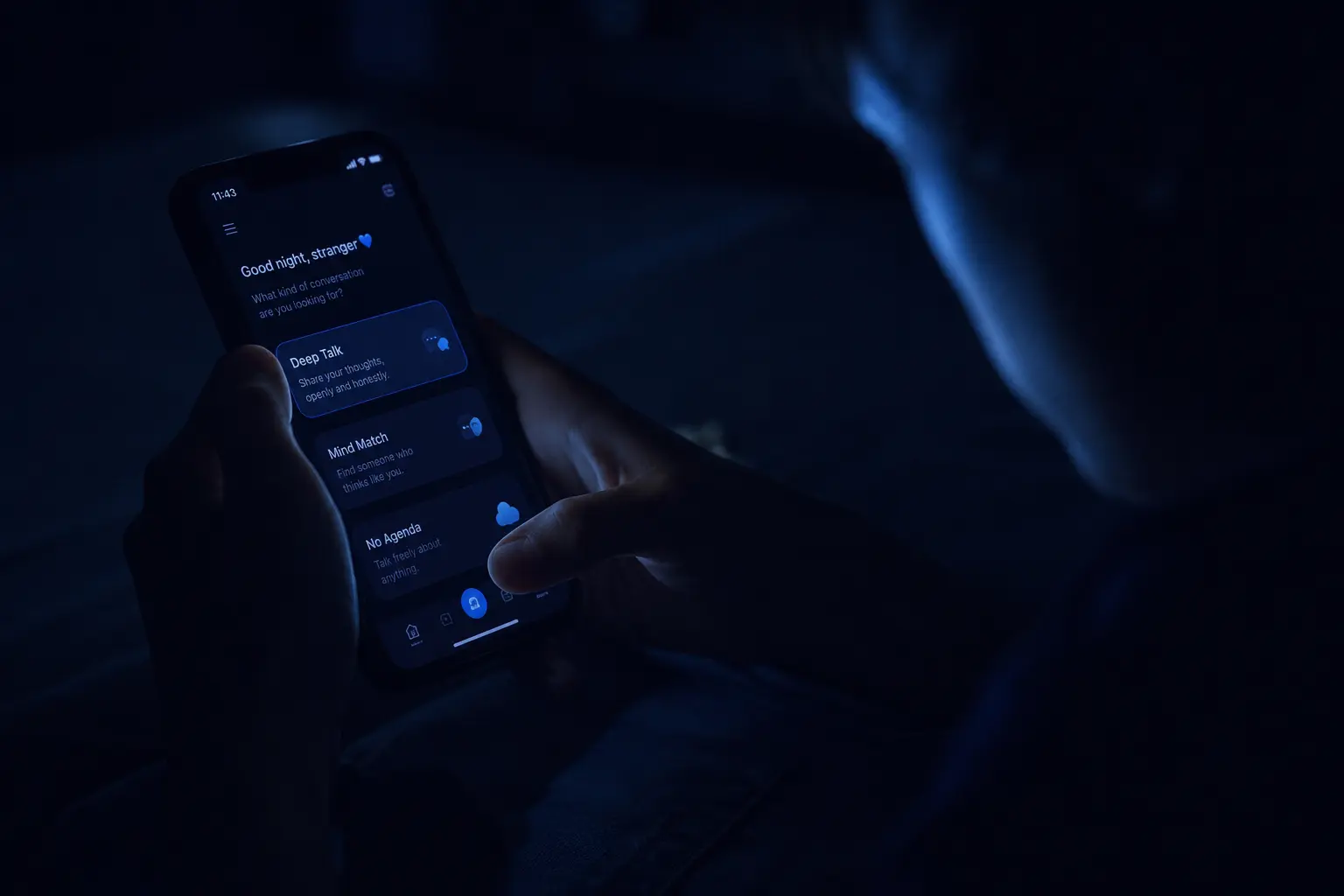
11:42pm. Phone screen too bright for the room.
The school friends' group chat is still lit up from earlier, but nobody's said anything in two hours. Just a meme, sitting there.
You wanted to write something else. Something about how the interview went badly, how tired you are of pretending you're fine, how you've been staring at the ceiling more than usual lately.
You typed it. Deleted it. Typed it again.
Then, twenty minutes later, you told almost all of it to someone you'd known for six days. No face attached, no name that means anything, nothing left to protect.
And it felt easier than it should have.
Not that the stranger listened. That the friends of six years felt harder to talk to than the stranger of six days.
Why the people who know you best can feel the hardest to talk to
This is the bit nobody really explains to you: what makes a conversation feel safe was never really about how long you've known someone.
You'd think closeness makes honesty easier. More history, more inside jokes, more late-night calls, that should add up to more safety, right? Except it often works the other way. The people who've known you longest also know exactly what version of you they expect, and breaking that version, even a little, can feel like letting them down.
Think about a hostel room in Kota or Indore. Four people sharing a space for three years, watching each other at their worst and their most petty, yet still performing "I'm fine" every single day because admitting otherwise means explaining, and explaining means answering questions you don't have answers for yet.
Or the family WhatsApp group. Cousins, uncles, that one relative who forwards everything before checking if it's even true. You're technically "close" to fifteen people in that group. You still couldn't tell a single one of them that you failed a CA paper, or that placement season is quietly wrecking you, without it becoming a whole thing.
There's the batchmate factor too, especially during something like CA prep or engineering placements, where the person listening to you might also be silently comparing themselves to you. Vulnerability gets complicated when support and competition come from the same person.
None of this is really anyone's fault. It's just what happens when a relationship carries too much history. History builds expectations, and expectations make certain truths feel expensive to say out loud. If you've ever felt completely misunderstood by people who've known you for years, this is probably part of why.
The real reason a near-stranger can feel safer than a close friend
Here's the part that actually explains the 11:42pm moment.
Back in the 1970s, psychologist Zick Rubin studied something he called the "stranger on a train" phenomenon, the tendency people have to open up more freely to someone they'll likely never see again than to people already in their life. Sidney Jourard, who spent years researching self-disclosure, argued this happens because strangers work as a low-risk testing ground. You can say the messy, unfinished thing without it following you into tomorrow.
Add anonymity on top of that, and the effect gets stronger. Researcher John Suler described what he called the online disinhibition effect, where not being fully identifiable makes people more willing to say what they actually feel instead of what they think they should say. No face means no visible judgment forming in real time. No name means no social record trailing behind it.
It was never really about how much someone knows you. It's about how safe you feel opening up to them, and what it would cost you if this specific person judged you for it. Low cost, more honesty. High cost, careful and guarded, even with people you love.
This is essentially what psychologists mean when they talk about psychological safety in workplaces, except it applies just as much to an ordinary conversation between two people at midnight. And it's oddly enough, why it can feel easier to open up to a stranger online than to say the same thing out loud across a dinner table.
So where do you actually take the things you can't say out loud
Different options work for different situations, and it's worth being honest about what each one is actually good for.
Therapy is structured, professional support from someone trained to hold difficult things. If what you're carrying is heavy or ongoing, a therapist is the right call, not a stand-in for one. Journaling helps you organise your own thoughts, but a page can't respond to you, and sometimes what you need isn't clarity. It's someone actually hearing you say it out loud.
Talking to friends is still, in most cases, the best option, when it's available and it feels safe to do. The problem was never friendship itself. It's that not every feeling has a friend who's the right fit for it at that particular moment, especially the messier, less flattering ones nobody wants to admit out loud.
That gap is where anonymous conversations, and the apps built around them, tend to show up. Not as a replacement for therapy or friendship. More like a pressure release for the version of a thought that isn't ready for either yet, something you can say once and see if it even makes sense before deciding who deserves to hear it next.
This is roughly where Artha comes in
I built Artha after noticing this exact pattern in my own life, that the conversations which actually helped were rarely the ones with people who already knew everything about me. Artha is built so you're matched based on what's actually on your mind, connecting you with someone who wants the same kind of conversation, rather than just throwing you into random chat. It's anonymous by design, because a safe space to talk when nothing else feels like one is genuinely hard to describe until you've had one. What an honest anonymous conversation actually feels like is something most people only understand after trying it once.
A quick note from me
I'm 18, doing my B.Com, prepping for CA, and I built most of Artha at night from a hostel-adjacent room in Indore, originally from Singrauli. I'm not a therapist and I'm not a software engineer by training either. I built this because I was the person typing something at midnight and deleting it, over and over, before finally saying it to a stranger and feeling lighter afterward. That's really the only credential I have here. It felt honest enough to build something around.
Safety in a conversation was never really about time spent knowing someone. It's about how safe it feels to be wrong, or messy, or unfinished, in front of them.
Who's the person, or the space, you actually feel that with? And does it match who you'd expect it to be?
Quick answers
Things people usually want to know.
What makes a conversation feel emotionally safe?
A conversation feels emotionally safe when there's little to no social cost to being honest in it. That usually depends more on how the other person is likely to react than on how long you've known them.
Why do I feel safer talking to strangers than close friends?
Strangers carry no history and no future consequences, so there's less at stake in being honest. This is sometimes called the 'stranger on a train' phenomenon in psychology, first studied by Zick Rubin.
What is the 'stranger on a train' effect?
It describes the tendency to open up more freely to someone you'll probably never see again than to people already in your life, since there's no ongoing relationship to protect or damage.
Is it healthy to open up to strangers online instead of friends?
It can be, as one part of how you process things, especially for thoughts that aren't ready to be shared with people who know you. It works best alongside, not instead of, real friendships and professional support when needed.
How can I make someone feel safe opening up to me?
Reacting without visible judgment matters more than saying the 'right' thing. People generally open up when they trust the reaction won't change how they're seen afterward.
Why does anonymity make people share more honestly?
Anonymity removes the fear of an immediate, visible reaction and the risk of it affecting your image later. Researcher John Suler described this as part of the online disinhibition effect.
Is talking to an anonymous stranger the same as therapy?
No. Therapy involves trained, structured, ongoing support for specific issues. Anonymous conversations can help you process a thought in the moment, but they aren't a substitute for professional mental health care.
Why do close friendships sometimes feel unsafe to be fully honest in?
Close relationships carry history and expectations, so being honest can feel like it risks the relationship itself. This isn't unique to any one friendship, it's a fairly common pattern.
How do I know if a conversation is emotionally safe?
You usually know afterward. If you feel lighter and not judged, it was safe. If you feel like you have to manage how you're perceived, it probably wasn't.
What's the difference between psychological safety and trust?
Trust is built over time through repeated experience with a specific person. Psychological safety can exist immediately, even with a stranger, if the perceived risk of honesty is low.