
Apps to Talk Anonymously About Feelings in India (2026)
May 26, 2026 · 7 min read · by Shivam Kushwaha, Artha founder
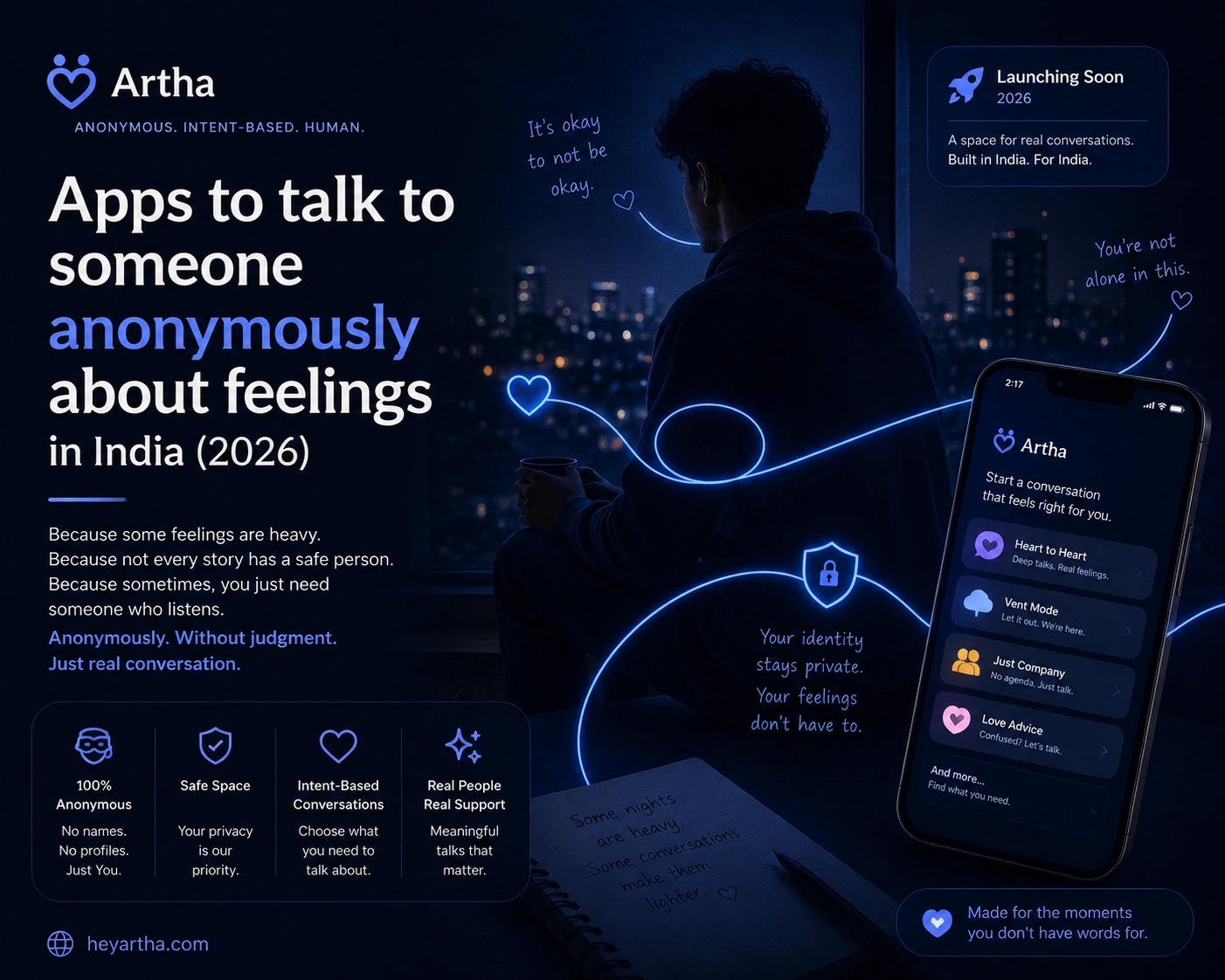
2:47am. Hostel room. Roommate is asleep. The ceiling fan sounds louder at this hour for some reason.
There's something sitting on your chest — hard to name, harder to explain. Not exactly sadness. Not anger. Just something that needs somewhere to go. You open WhatsApp. Scroll past the family group. Past your best friend's name. You start typing something. Then you delete it. You close the app, stare at the ceiling, and wonder if there's anyone, anywhere, who'll just listen — without making it a whole thing. Without asking why you didn't say something sooner.
That feeling is more common than anyone actually talks about. And the fact that you're still searching for where to put it says something.
Why "just talk to someone" doesn't work the way people say it does
The advice is always the same. "Baat karo kisi se." Don't keep things inside. But that advice skips the actual problem — talk to whom, exactly?
Your parents are already worried about fees, placements, results. Your friends have their own weight, and you don't want to be the one who always brings the mood down. The college group chat is for memes. Instagram is for highlights. WhatsApp has eighteen people in it who know your mother personally. There's this whole layer of emotional life — the stuff that feels too small to be a crisis but too heavy to carry alone — that just doesn't have a place to go.
And sometimes the feelings aren't even dramatic. It's the kind of loneliness that's hard to explain to someone who already knows you. The pressure with no name. A sense of falling slightly behind everyone else, even when you can't say behind in what. That's the part that makes reaching out feel harder, not easier.
Why opening up to a stranger can feel easier than talking to someone close
There's a thing psychologists call the "stranger on a train" effect. People tell strangers things they've never told their closest friends. Not because strangers are more trustworthy. Because there are no stakes. No shared history. No one to bring it up three years later at a family gathering.
When someone already knows you, everything you say comes with context. You're not just a person having a hard week — you're the person their parents ask about, the one who was supposed to have things figured out by now. That context, even when it comes from love, can make it harder to be honest about what's actually going on.
And if you grew up in a small town, or a joint family, or anywhere your reputation travels faster than you do — you already know this. It's not weakness. It's just how the brain calculates risk. Which is probably why opening up to a stranger online can feel safer than starting that conversation with someone who already has an opinion of you.
What your actual options look like right now
If you're searching for an app to talk to someone anonymously about feelings in India, you'll find a few different types. None of them are perfect. But some fit certain moments better than others.
Therapy platforms like YourDost or iCall are built for structured support — sessions, progress, professional guidance. Genuinely useful if you're working through something clinical, like anxiety that's affecting your daily life. But they're not built for 11pm when you just want to talk. They're built for process. That's a different thing entirely.
Random anonymous chat apps, the ones that connect you to strangers without any context, can go anywhere. Sometimes you find something real. A lot of the time you don't. And whether anonymous chatting is actually safe depends more on how the platform is designed than on whether it promises anonymity.
Journaling is useful for processing thoughts on your own. But it can't give you the feeling of being heard. And sometimes that's exactly the gap — not analysis, not advice. Just someone on the other end who's actually there.
Reddit and anonymous forums exist, and they help plenty of people. But they're public, slow, and what you get back is completely unpredictable.
So the honest answer is: the right option depends on what you actually need right now. The mistake most people make is assuming one platform covers all of it.
What changes when the intention is shared
Something I kept noticing when I was looking for this kind of space — before I built anything — is that anonymity alone wasn't the answer. The problem wasn't just that I didn't want to be identified. I wanted a specific kind of conversation, and I had no way to signal that to whoever was on the other end.
"I want to vent" is different from "I want company." "I want to think something through out loud" is different from "I want someone to tell me it'll be okay." These are different needs. Most platforms treat them like they're the same thing, and maybe that's why those conversations so often go nowhere.
That's why I ended up building Artha. It's anonymous, and before you get matched, you choose what's actually on your mind. You get connected with someone who wants the same thing. No names. No profiles. What those conversations actually feel like is something I still find hard to describe, but they tend to go somewhere real.
A note from the person who built this
I'm Shivam. I'm 18, studying commerce, preparing for CA. I'm originally from Singrauli, a small town in MP, and moved to Indore a while back. I built Artha during late nights because I kept searching for something like it and couldn't find it. Not because I had a startup plan. Because at some point I was the person lying awake with no clean place to put what I was feeling. I know what it's like when you want to reach out but something stops you. That's the only authority I have here. I think it's enough.
Some feelings are too heavy for Instagram and too tangled for a WhatsApp message. That's not a personal failing. Those spaces just weren't built for this.
What kind of conversation do you wish you could have with someone who doesn't already know you?
Key References & External Resources
Quick answers
Things people usually want to know.
What is the best app to talk to someone anonymously about feelings in India?
There's no single best answer — it depends on what you need. If you want structured support, platforms like YourDost or iCall are a start. If you want actual conversation with another person, intent-based platforms like Artha match you with someone who wants the same kind of conversation you do — without profiles or names.
Is it safe to use anonymous chat apps in India for emotional conversations?
It depends on the platform's design. Safety comes from features like no personal data storage, no profile-based tracking, and active moderation — not just from a promise of anonymity. Always check what data a platform stores before sharing anything personal.
Are apps to talk anonymously about feelings free in India?
Many offer free tiers. Artha, for instance, has a free plan that gives you a set number of matches daily. Paid plans unlock more conversations and features, but the core experience is accessible without spending anything.
What's the difference between anonymous chat apps and therapy apps?
Therapy apps are for structured, professional support over time. Anonymous chat apps are for real-time conversation — venting, connecting, feeling heard in the moment. They serve different needs, and you don't have to pick just one.
Will the other person know who I am on anonymous platforms?
On properly built anonymous platforms, no. You're matched without sharing your name, phone number, or social profile. But read each platform's privacy policy — some store conversation history even if no names are attached.
Why do I find it easier to open up to strangers than to people I know?
Psychologists describe this as the 'stranger on a train' effect. When someone doesn't know you, there are no stakes. No shared history that colors what you say. The conversation ends and doesn't follow you. It's not a flaw — it's a reasonable response to social risk.
Can I use an anonymous chat app if I'm feeling really low or depressed?
You can, but if you're dealing with something serious — thoughts of self-harm, prolonged depression — please reach out to a professional or call iCall at 9152987821. Anonymous chat can help with loneliness and emotional weight, but it isn't a substitute for clinical support when you actually need it.
What does 'intent-based' anonymous chat mean?
It means you choose the kind of conversation you want before getting matched. Instead of being randomly connected to anyone, you signal your intent — like 'I want to vent' or 'I just want company' — and get matched with someone who wants the same thing. It makes conversations more likely to actually go somewhere.
Is Artha available across India? Is it free to start?
Yes. Artha works as a PWA (progressive web app) on any device and is available across India. There's a free plan with daily matches — you can start without entering payment details.
Are anonymous conversations on these apps stored or recorded?
This varies by platform. On Artha, users can optionally save a conversation to Memories if both people want to — but there's no automatic logging. Always check a platform's privacy terms to understand exactly what's stored and for how long.
More from Artha
Other things we've been writing about.
Why It's Easier to Open Up to a Stranger Online
Telling a stranger online how you really feel is often easier than telling your closest friend. Here's the quiet psychology behind it — and why it's okay.
Is anonymous chatting safe? What to know before you start
Thinking about trying anonymous chat but not sure it's safe? An honest guide to the real risks, the real benefits, and how to protect yourself first.
Feeling lonely but scared to reach out — what to actually do
Wanting connection but too scared to reach out isn't laziness — the fear is real. Here's why it happens, and the smallest first step you can take today.