Unemployed Graduate Living at Home: The Shame
October 2, 2026 · 9 min read · by Shivam Kushwaha, Artha founder
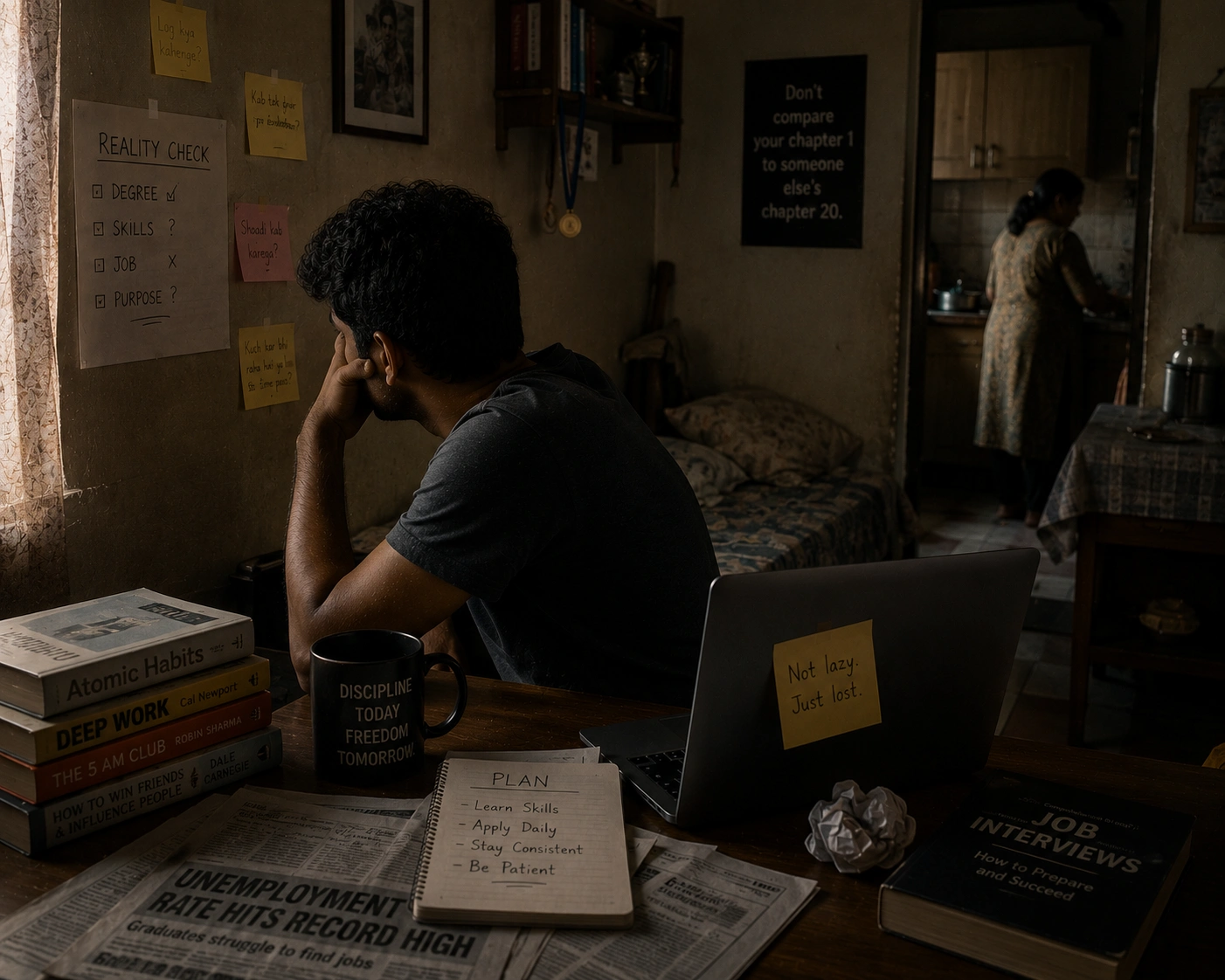
Your room looks almost exactly the way it did before college, same posters, same shelf of old textbooks, except now it doesn't feel like a temporary stop between semesters, it feels like somewhere you've quietly become stuck. Your mother knocks before dinner most nights with the same gentle question, "any updates today," and you give the same answer you gave yesterday, watching her try not to look disappointed while you try not to feel like the degree on your shelf was somehow a mistake.
Why This Specific Situation Feels So Heavy
Here's the honest truth about being an unemployed graduate living at home: it's rarely just about the job search itself, even though that's what everyone, including you, keeps treating it as the whole problem. It's about a specific, disorienting kind of regression, moving back into a childhood room, back under parental rules and rhythms you'd already outgrown once, at exactly the moment you expected to be moving in the opposite direction, toward independence, your own place, your own money, your own life.
There's real research behind why this period takes a genuine psychological toll, not just an inconvenient one. A large systematic review of longitudinal studies found unemployment nearly doubles the risk of mental health problems compared to regular employment, and one Australian study specifically focused on young adults aged twenty to twenty-four found more than double the odds of depression symptoms among the unemployed in that age group (a systematic review and meta-analysis on the mental health effects of unemployment). That's not a character flaw showing up in the data, it's a well-documented pattern, unemployment genuinely and measurably affects mental health, and the effect appears to hit young adults especially hard, right at the life stage where you're already navigating so much else for the first time.
There's a specific Indian dimension that makes this even heavier, the deep cultural association between a completed degree and an almost automatic next step into a stable job. When that expected sequence doesn't happen on schedule, it doesn't just feel like a delay, it feels like a broken promise the whole system made and somehow didn't keep, one that reflects, unfairly but persistently, back onto you rather than onto the actual job market conditions that produced the gap in the first place.
If family gatherings during this stretch have turned into their own specific gauntlet of vague, deflecting answers about what you're up to, living at home means there's no escaping a version of that same question daily, asked more gently by parents, perhaps, but asked all the same, in a house you can't simply leave at the end of the evening the way you could a wedding hall.
What Living at Home Adds to the Weight
Financial dependence is its own specific strain here, separate from the emotional weight of unemployment itself. Needing to ask for money for things you used to pay for yourself, a haircut, a train ticket, a night out with friends, chips away at a sense of adult autonomy in small, repeated ways that add up over months, even when your parents genuinely don't mind providing and never make you feel bad about asking.
There's also a specific loss of privacy and rhythm that comes with living under someone else's roof again, someone else's schedule, someone else's expectations about when you should be awake, when you should be job hunting, whether an evening spent unwinding counts as productive enough given the circumstances. Even loving, well-meaning parents unconsciously slip into a supervisory role during this period, checking in more than they would with an employed adult child, and that shift, however gentle, can feel like a reversion to a version of yourself you'd already moved past.
The comparison trap here runs in multiple directions at once too, watching friends from your graduating batch post about new jobs and first salaries, watching younger cousins seem more settled than you, and watching your own parents field questions from their own social circle about what you're doing now, questions that land on them almost as heavily as they land on you, even though you're the one actually living through the gap.
There's also a specific strain that shows up around household dynamics that shift in small, easy-to-miss ways once you're back home as an adult rather than a visiting student. Chores that used to be a given during college breaks can start to feel like they carry a different, heavier weight now, a subtle sense that contributing more around the house is somehow owed in exchange for room and board, even in families who'd never actually frame it that transactionally out loud. That unspoken shift is worth noticing, because it can quietly add a layer of obligation on top of an already difficult period, one that rarely gets discussed directly even as it shapes the daily mood of the house.
Siblings add their own layer to this too, if there's a younger one still in school or a working one who left home already. A working sibling's presence in the house, even briefly during a visit, can trigger a specific comparison that stings more than comparisons with distant classmates ever do, precisely because it's happening under the same roof, at the same dinner table, in front of the same parents who are, whether they intend to or not, seeing the two of you side by side.
If strangers online sometimes manage to say the genuinely helpful thing your own family, too close to the situation, can't quite land on, that's especially true during this specific stretch, where every conversation at home carries the weight of shared history and mutual worry, making it hard for anyone in the house to just listen without also trying to fix, reassure, or subtly steer.
What Actually Helps
The most useful shift is separating your current employment status from your actual worth and capability as clearly and deliberately as you can, even though that distinction is genuinely hard to hold onto some days. A job search taking longer than expected is information about market conditions, timing, and circumstance, not a verdict on your intelligence or your degree, and it's worth repeating that to yourself as many times as it takes to actually start believing it.
It also helps to build some structure into days that can otherwise feel shapeless, a consistent wake time, dedicated hours for actual job applications, and clearly separated time for rest or other pursuits, rather than one long, undifferentiated stretch where job hunting and everything else blur together into a single anxious blob of a day. Structure doesn't speed up the job market, but it does protect your own sense of agency while you're waiting on things you genuinely can't control.
It's worth having an honest, calm conversation with your parents about what kind of support actually helps versus what adds pressure, whether that's asking for fewer daily check-ins, or being explicit about needing space some evenings without it being read as avoidance. Most parents, once it's named plainly, are willing to adjust, they're often anxious themselves and expressing that anxiety through check-ins because they don't know what else to do with it.
That same conversation is a good moment to be honest about money too, rather than letting financial dependence stay an unspoken discomfort in the background of every request. Agreeing on some clear, mutually understood expectations, what you'll ask for, what feels reasonable to both sides, whether there's a small allowance or a clear boundary around what's covered, tends to remove a surprising amount of quiet tension from daily life, replacing a vague, ongoing awkwardness with something both sides have actually talked through and agreed on together.
It also helps to find some connection outside the house during this period, a friend, a former classmate in a similar situation, anyone who can be a sounding board that isn't also emotionally invested in your outcome the way your parents inevitably are. Talking to someone who isn't watching the situation with the same worried closeness can make the whole experience feel less like a family crisis and more like a genuinely common, temporary chapter that plenty of people your age are moving through right alongside you.
It's also worth reframing the job search itself, at least internally, as one part of your week rather than the entirety of it. Treating the whole day as an unbroken job hunt, with rest or hobbies constantly feeling like they need to be earned or justified first, tends to make the process feel far more exhausting and identity-consuming than it needs to. Giving yourself real, unapologetic time for things that have nothing to do with employment, even during an active search, protects some part of your sense of self from being entirely defined by an outcome that, right now, isn't fully in your control.
It's worth being specific, too, about what "progress" actually looks like during a stretch like this, since a job offer isn't the only meaningful marker along the way. Applications sent, interviews landed, skills sharpened, a clearer sense of what you actually want next, all of these are real movement, even on weeks that don't end in an offer letter. Recognizing that smaller progress, rather than measuring every single day purely against the binary of employed or not, makes the waiting considerably easier to sit with.
Where Artha Fits, If It Does
A lot of what makes this period hard to talk about honestly is that admitting how heavy it feels, even to your own parents, risks adding to their worry on top of your own. That's part of why Just Talk Shop exists inside Artha, a place to say "I'm living at home, unemployed, and I don't know how to explain how heavy this actually feels" to someone anonymous who understands the specific weight of this exact chapter, without turning the conversation into either forced optimism or another round of job-search advice you didn't ask for.
This stretch, however long it ends up lasting, is a chapter, not a permanent state, whatever the daily "any updates" conversation at dinner might make it feel like some evenings. The degree on your shelf still means what it always meant. The timeline just took longer than the one everyone quietly expected.
If you set the job search aside for a moment, what's actually the hardest part of this chapter for you, the waiting, the dependence, or the sense of falling behind, and which one deserves more of your energy to actually name and deal with directly?
Quick answers
Things people usually want to know.
Why does living at home unemployed after graduation feel so heavy?
It's rarely just about the job search. It's a disorienting regression, moving back into a childhood room and parental rhythms you'd already outgrown, right when you expected to be moving toward independence instead.
Is unemployment actually linked to worse mental health for young graduates?
Yes, a systematic review of longitudinal studies found unemployment nearly doubles mental health risk compared to regular employment, and one Australian study of 20 to 24 year olds found more than double the odds of depression symptoms specifically in that age group.
Why does living at home unemployed feel worse than just being unemployed?
Financial dependence adds its own strain, needing to ask for money for things you used to pay for yourself chips away at a sense of adult autonomy in small, repeated ways that add up over months.
How do I deal with my parents checking in on my job search constantly?
Have an honest, calm conversation about what kind of support actually helps versus what adds pressure. Most parents adjust once it's named plainly, they're often anxious themselves and don't know what else to do with that anxiety.
Is it normal to feel behind when friends from my graduating batch get jobs first?
Very common, and it runs in multiple directions, watching friends post new jobs, younger cousins seem more settled, and your own parents field questions from their social circle about what you're doing now.
How do I build structure into unemployed days at home?
A consistent wake time, dedicated hours for applications, and clearly separated time for rest, rather than one long undifferentiated stretch where job hunting and everything else blur together into one anxious blob of a day.
Should I feel guilty about not doing more chores while living at home unemployed?
Not automatically, though it's worth noticing if an unspoken sense of owing more around the house has crept in. That's worth naming directly rather than letting it quietly shape the mood of the house.
What counts as real progress during a job search that isn't landing offers yet?
Applications sent, interviews landed, a clearer sense of what you actually want, all real movement even on weeks that don't end in an offer. Measuring only the binary of employed or not makes the waiting much harder.
Does an unemployment gap mean my degree was a waste?
No. The degree still means what it always meant, the timeline just took longer than the one everyone quietly expected, and that's information about market conditions, not a verdict on your capability.
Who should I talk to while unemployed and living at home?
Someone outside the house, a friend or former classmate in a similar situation, who isn't as emotionally invested in the outcome as your parents are. Talking to them can make the experience feel like a common chapter instead of a family crisis.