US CPA vs US CMA: The Fully-International Accounting Route
November 24, 2026 · 10 min read · by Shivam Kushwaha, Artha founder
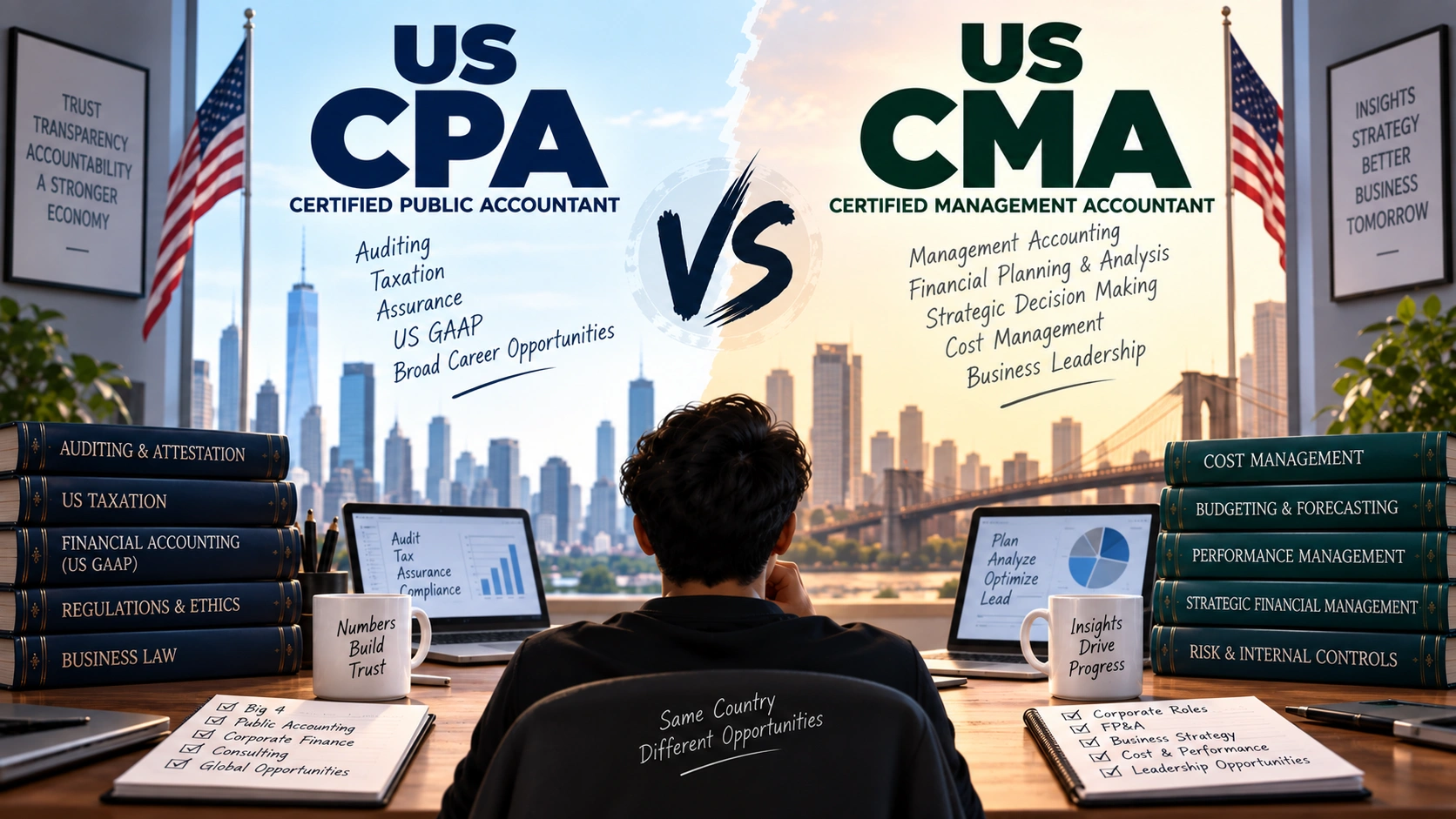
Two American credentials, both in accounting, both carrying the letters C and A in their names, and both frequently mentioned in the same breath when someone is looking at a US or GCC career track. One is CPA, a state-licensed credential that authorises you to sign audit opinions and attestations. The other is CMA, a certification focused on management accounting and financial planning and analysis. They're both American. They're both globally recognised. They're built for completely different work.
US CPA is a state-licensed credential requiring 150 credit-hours of education and four exam sections, granting audit and attestation authority under US law. US CMA is a two-part certification focused on management accounting and FP&A, requiring a bachelor's degree but not the 150 credit-hour threshold, with no signing authority anywhere. Both are American. Neither is Indian. And they're not interchangeable.
The actual numbers, side by side
| US CPA (AICPA) | US CMA (IMA) | |
|---|---|---|
| Governing body | American Institute of Certified Public Accountants, with licensure by individual US state boards | Institute of Management Accountants (IMA) |
| Structure | 4 sections: Auditing and Attestation, Financial Accounting and Reporting, Regulation, and Business Environment and Concepts (or discipline section under new 2024 format) | 2 parts: Part 1 (Financial Planning, Performance and Analytics), Part 2 (Strategic Financial Management) |
| Typical duration | 12 to 18 months across four sections, plus education evaluation timeline | 6 to 18 months across two parts |
| Education requirement | 150 credit-hours from a recognised institution, which is typically a bachelor's degree plus additional coursework beyond the standard 120-credit degree | Bachelor's degree or a related professional certification |
| Pass rate | Varies by section and state; generally between 45 and 55 percent across sections, per AICPA data | Part 1: approximately 45 percent; Part 2: approximately 50 percent, per recent IMA data |
| Statutory authority | Audit and attestation authority under US state law; can sign audit opinions and financial-statement attestations | None. No signing authority anywhere |
| Core focus | External audit, financial reporting, taxation, and business law under US GAAP and US auditing standards | Management accounting, financial planning and analysis, cost management, and strategic decision support |
| Where it's valued most | External audit roles at CPA firms, Big Four, companies with US-facing reporting requirements, and any role requiring statutory audit authority in the US | FP&A, management accounting, cost analysis, and strategic finance roles at MNCs and shared-service centres globally |
| Fee range (approximate) | ₹2 to ₹4 lakh including education evaluation, exam fees, licensing fees, and ethics exam, varying by US state | ₹1.5 to ₹2.5 lakh including IMA membership, entrance fee, and exam fees for both parts |
What US CPA is actually for
CPA exists to serve a specific legal function: the authority to sign audit opinions and attestations under US state law. The 150 credit-hour education requirement, the four-section exam structure, and the state-level licensure process are all built around ensuring that the person holding the credential has the knowledge and competence to execute that statutory function.
The credential's real strength is in roles where external audit authority is the actual job. Big Four firms, CPA practices, companies with US-facing financial reporting requirements, and any role that requires a licensed CPA to sign an audit opinion all need CPA specifically.
The real limitation is that CPA's curriculum is heavily weighted toward external audit and financial reporting. Someone aiming purely at management accounting or FP&A will find that CPA's syllabus doesn't go as deep into those specific areas as CMA's does. You end up covering a lot of audit and tax content that isn't relevant to the role you actually want.
What US CMA is actually for
US CMA was built for a different kind of finance work: internal financial planning, analysis, cost management, and strategic decision support. The two-part structure covers financial planning and performance analytics in Part 1, moving through to strategic financial management in Part 2.
The credential's real strength is in roles where analytical and strategic financial skills matter more than audit authority. FP&A teams, management-accounting functions, cost-analysis roles at MNCs, and decision-support positions in shared-service centres all value CMA's curriculum specifically because it focuses on the internal-facing work that CPA doesn't go deep into.
The real limitation is that CMA is a certification, not a licence. It cannot be used to sign audit opinions, attestations, or any other statutory filing. The distinction matters in any context where legal signing authority is required, which is exactly where CPA comes in.
The 150 credit-hour question
The single most common confusion point: US CMA does not require 150 credit-hours. That threshold is specific to CPA licensure, which is governed by individual US state boards of accountancy.
US CMA requires a bachelor's degree or a related professional certification. The 150 credit-hour requirement typically means completing additional coursework beyond a standard 120-credit bachelor's degree, which adds time and cost before you can even qualify for CPA licensure.
This is one of the key structural reasons CMA can be completed faster than CPA. It's not that the content is necessarily easier. It's that the education threshold is different, and the exam structure is narrower.
Where people get this decision wrong
The most common mistake is treating CMA as a stepping stone to CPA, assuming it's the "easier version" you do first. For someone targeting FP&A or management accounting, CMA is the complete credential. There's no need to add CPA unless your career goal specifically requires audit authority.
The reverse mistake shows up in people committing to the full CPA path without checking whether their actual career goal is internal finance and strategic analysis rather than external audit. CPA's 150 credit-hour requirement and four-section exam structure are significant investments for a role that doesn't need audit authority.
A third pattern involves people assuming that because CPA is more widely recognised, it's automatically the better option. In the specific context of FP&A and management-accounting roles, CMA's focused curriculum and lower time and cost commitment make it the more efficient credential.
The actual decision
The real question isn't which credential is more prestigious or more widely recognised in the abstract. It's whether your actual career goal requires the legal authority to sign audit opinions or the analytical skill set for internal financial planning and decision support.
If you're picturing external audit, attestation, or any role where a licensed CPA must sign an audit opinion under US law, CPA is the credential built for exactly that, and CMA cannot substitute for it.
If instead you're picturing FP&A, management accounting, cost analysis, or a strategic finance role where the actual daily work is analysing and advising on internal financial decisions rather than auditing external financial statements, CMA is built specifically for that, and CPA's heavier audit and tax curriculum is more than you need.
Different legal realities, not different prestige levels
US CPA and US CMA aren't really ranked against each other the way the search results make it look. One is a state-licensed credential with audit-signing authority. The other is a certification focused on the management-accounting side of finance with no signing authority.
Which legal and career reality do you actually want to be working inside? The answer determines which credential you need, not which one the internet thinks is better.
Quick answers
Things people usually want to know.
Which is better, US CPA or US CMA, for a career abroad?
Neither is universally better. US CPA grants audit and attestation authority under US state law and is essential for external audit roles. US CMA is a management-accounting certification focused on FP&A and decision support. The right choice depends on whether your target role requires audit authority or strategic financial analysis.
Can I do both US CPA and US CMA?
Yes. There is no structural conflict, and many professionals hold both. CPA covers external audit and financial reporting. CMA covers management accounting and FP&A. The combination is particularly valuable for senior finance leadership roles that require both competencies.
What is the main difference between CPA and CMA?
CPA is a state-licensed credential granting audit and attestation authority, requiring 150 credit-hours of education. CMA is a certification, not a licence, focused on management accounting and financial planning and analysis, with no statutory signing authority.
Does US CMA require 150 credit hours?
No. US CMA requires a bachelor's degree or a related professional certification. The 150 credit-hour requirement is specific to US CPA licensure, which is governed by individual US state boards of accountancy.
Can a US CMA sign audit reports?
No. US CMA is a certification, not a licence. It grants no audit or attestation authority anywhere. Only licensed CPAs can sign audit opinions and attestations under US law.
How long does US CPA take compared to US CMA?
US CPA typically takes 12 to 18 months across four sections, depending on state requirements and exam pacing. US CMA can be completed in 6 to 18 months across two parts.
What are the fees for US CPA vs US CMA?
US CPA costs approximately ₹2 to ₹4 lakh including education evaluation, exam fees, licensing fees, and ethics exam, depending on the US state. US CMA costs approximately ₹1.5 to ₹2.5 lakh including IMA membership, entrance fee, and exam fees for both parts.
Is US CPA valid in India?
US CPA is recognised by many Indian employers, particularly Big Four firms, MNCs, and companies with US-facing reporting requirements. It does not grant any statutory authority under Indian law.
What kind of work does a CPA do that a CMA doesn't?
External audit, attestation, and financial-statement opinions under US auditing standards. These are statutory functions that require a licence, not just a certification.
What kind of work does a CMA do that a CPA doesn't?
Management accounting, financial planning and analysis, cost management, and strategic decision support. CMA's curriculum goes deeper into internal decision-making than CPA's external-audit-focused syllabus.