US CMA vs CFA: Inside the Business or Facing the Market
March 12, 2027 · 10 min read · by Shivam Kushwaha, Artha founder
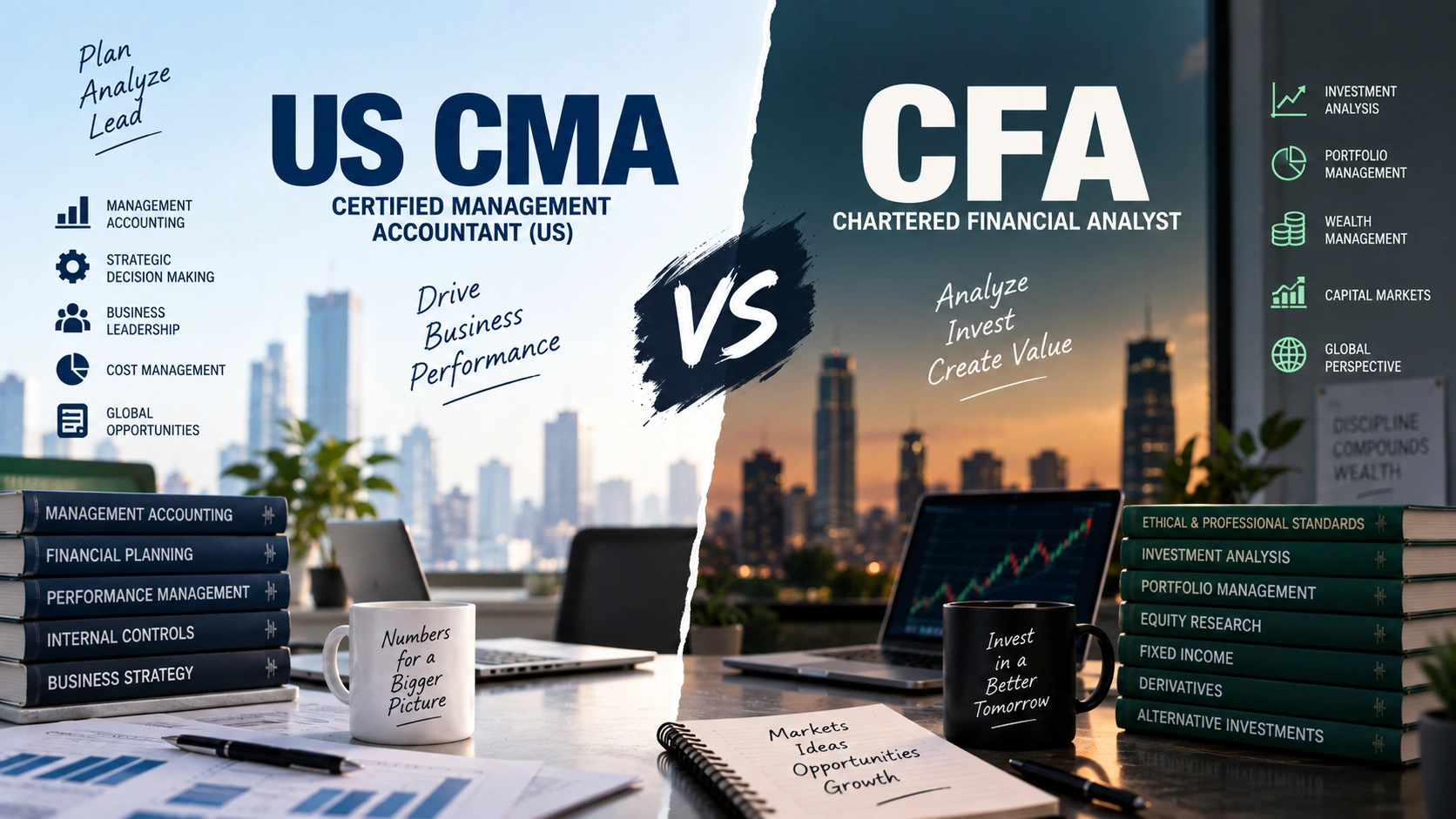
Quick disambiguation before anything else, since this exact name collision trips up a lot of people: this comparison is about US CMA, the Institute of Management Accountants' credential, not Indian CMA through ICMAI. They're entirely different institutes with entirely different structures, and getting this wrong at the start wastes the rest of the comparison.
With that settled, this is a genuinely useful decision for someone drawn to finance broadly but unsure which specific direction to take it. One Quora answer addressing exactly this comparison put the core distinction plainly: CFA sits more in investment banking, portfolio management, and markets-facing work, while US CMA offers diversified career opportunities across nearly every sector and function of an organisation, an internal, business-facing credential rather than a market-facing one.
US CMA typically takes 6 to 18 months across two parts and is built around internal management accounting, budgeting, forecasting, and business decision support. CFA typically takes 2 to 4 years across three levels and is built around investment analysis, valuation, and portfolio management. The real question underneath this comparison isn't which one is more prestigious. It's whether you want to work inside a business, helping it make decisions, or facing the market, deciding where money should go.
The actual numbers, side by side
| US CMA (IMA) | CFA (CFA Institute) | |
|---|---|---|
| Governing body | Institute of Management Accountants, USA | CFA Institute, US-headquartered, global |
| Structure | 2 parts, 4 hours each | 3 levels: Level I, II, III, each a separate exam |
| Core focus | Budgeting, forecasting, cost management, internal decision support | Investment analysis, valuation, portfolio management |
| Typical duration | 6 to 18 months, largely self-paced | 2 to 4 years depending on pacing and deferrals |
| Reported total cost | Professional entrant approximately $1,585; student entrant approximately $1,078, per IMA's published fee schedule | Approximately ₹3 to 4 lakh across all three levels, based on coaching-sourced estimates |
| Pass rates | Reported at roughly 45 to 50% per part, though IMA does not publish this as consistently or prominently as CFA Institute publishes its own figures | Level I: 39% of 31,566 candidates worldwide passed in May 2026; 45% of 24,006 passed in February 2026, both per CFA Institute's own announcements |
| Work orientation | Internal-facing: works within a company's finance function across nearly any industry | Market-facing: works with external investments, portfolios, and capital markets |
| Where it's valued most | GCCs, MNCs, manufacturing and services companies needing internal FP&A and budgeting expertise, across virtually any sector | Equity research, asset management, portfolio management, buy-side investment roles |
| Global recognition | Recognised across roughly 150+ countries where IMA operates | Strong specifically within global investment management circles |
Salary comparisons between the two circulate widely and conflict substantially, since they lead toward genuinely different job categories. Treat any specific comparative figure as a reported estimate, and note that US CMA's cross-industry applicability means its earning range spans a much wider variety of roles than CFA's more concentrated markets-focused range.
What US CMA is actually for
US CMA is built for internal, business-facing finance work: budgeting, forecasting, cost management, and the kind of decision support that happens inside a company rather than in an external investment relationship. One Quora answer on someone considering US CMA plus CFA together captured this well: US CMA offers diversified career opportunities in every field or every sector of organisations, a genuinely broad applicability that reflects how the credential is built to serve internal finance functions regardless of industry.
That breadth is the real strength here. Someone with a US CMA can work in manufacturing, services, tech, or virtually any sector that needs internal budgeting and forecasting expertise, without being tied to one specific industry the way some specialist credentials are. GCC finance teams and MNC India offices frequently list "IMA-certified" specifically when they want someone who can speak the language of internal financial planning without necessarily coming from an external audit or investment background.
The real limitation is that US CMA doesn't build investment analysis or portfolio-management skill at all. Someone whose actual interest is markets, equity research, or capital allocation decisions will find US CMA's curriculum, however well-suited to internal finance work, simply doesn't touch that specific domain, since the two credentials were built to solve genuinely different problems from the start.
What CFA is actually for
CFA is built around judging whether an investment is worth making and how to construct and manage a portfolio of them responsibly, a globally standardised skill set concentrated specifically within investment management rather than spread across general business functions. The same Quora answer comparing the two put it clearly: if the goal is investment banking or portfolio management specifically, CFA is the better fit, since its curriculum goes deep into exactly that domain in a way US CMA's broader internal-finance focus doesn't.
The real appeal of CFA is depth within a specific, high-stakes domain. Buy-side research, asset management, and portfolio management roles frequently require or strongly prefer the charter, and CFA Institute's own transparently published pass rates by session, recently 39 to 45% at Level I, give real, verifiable evidence of the exam's difficulty rather than a vague marketing claim.
The real limitation runs the opposite direction from US CMA's. CFA doesn't build the broad, cross-industry internal finance competence that US CMA is specifically designed around. Someone whose actual interest is working inside a business's finance function, budgeting, forecasting, cost control, across whatever industry they end up in, will find CFA's markets-and-investment-concentrated curriculum doesn't map onto that kind of work.
Where people get this decision wrong
The most common mistake is choosing CFA reflexively because it's the more globally recognised, more frequently discussed name in career forums, without checking whether the actual daily work, markets and investment analysis, genuinely matches what someone wants. Someone drawn to "finance" in a general sense, without a specific pull toward investment decisions over internal business decisions, can end up pursuing CFA's demanding, multi-year path only to discover post-qualification that the actual daily work, equity research or portfolio construction, wasn't quite what they'd pictured when they thought "finance career."
The reverse mistake happens with people choosing US CMA specifically because it's faster and cheaper, without checking whether internal finance work, rather than markets-facing investment work, genuinely interests them. Someone whose real pull is toward capital markets and investment decisions can clear US CMA relatively quickly, only to find the credential doesn't open the specific markets-facing doors they actually wanted, since US CMA's curriculum and professional recognition concentrate in a different direction entirely.
A third pattern involves treating the two as a natural, obviously synergistic combination without being clear about which one is the actual primary interest. One Quora answer weighing US CMA plus CFA together noted that both are genuinely strong, globally recognised credentials in their own domains, but the practical value of combining them depends heavily on whether someone's actual target role genuinely uses both skill sets, internal decision support and external investment analysis, rather than pursuing both simply because more credentials feels safer.
A fourth pattern shows up in people underestimating just how different the daily work actually feels between the two, even though both get labeled "finance careers" in casual conversation. US CMA-anchored work involves sitting inside a company, understanding its specific operations, and helping leadership make internal decisions with that context. CFA-anchored work involves sitting outside companies, analysing them as investment opportunities, and making capital allocation decisions based on that external analysis. These are genuinely different vantage points, not two versions of the same job.
The actual decision
The real question isn't which credential is more prestigious or which pays more on average, since both lead toward genuinely different, hard-to-compare job categories. It's whether you want to work inside a business, helping it plan, budget, and make internal decisions across whatever industry you end up in, in which case US CMA's broad, cross-sector applicability fits that goal directly, or whether you want to work facing the market, analysing investments and making capital allocation decisions from outside the companies you're evaluating, in which case CFA's specifically markets-focused curriculum fits that goal instead.
If you're still genuinely unsure which of these two vantage points, inside the business or facing the market, actually appeals to you more, it's worth thinking concretely about whether you'd rather spend your days understanding one company's operations deeply enough to help it plan its next quarter, or analysing many companies from the outside to decide where capital should flow. Some professionals do pursue both, particularly those whose careers eventually span internal finance leadership and investment decision-making, but starting with genuine clarity about which vantage point pulls you more tends to matter more than pursuing both credentials reflexively.
Where Artha fits
Traders' Talk and CA Talks on Artha both exist because this exact distinction, internal business-facing work versus external market-facing work, gets flattened into "which finance credential should I get" far too often, when the honest answer depends on which vantage point you actually want to spend your career working from.
I'm not selling US CMA prep or CFA coaching. I just wanted this comparison written by someone with nothing riding on which one you pick.
Inside the business, or facing the market
US CMA points toward working inside a company, helping it plan and make internal financial decisions across nearly any industry. CFA points toward working facing the market, analysing investments and making capital allocation decisions from the outside. Neither is the more impressive credential in the abstract. The honest question is which vantage point, internal or external, genuinely pulls you.
Do you want to help a business make its own internal decisions, or help decide where capital should flow into businesses from outside them?
Quick answers
Things people usually want to know.
Is US CMA better than CFA?
Neither is universally better. US CMA is built for internal, cross-industry business-finance work: budgeting, forecasting, and decision support. CFA is built for markets-facing investment analysis and portfolio management. The right choice depends on which kind of work you actually want.
Is this comparison about US CMA or Indian CMA?
Strictly US CMA (IMA), not Indian CMA (ICMAI). The two are entirely separate credentials from different institutes, and comparing CFA against the wrong one produces a misleading answer.
Which takes less time, US CMA or CFA?
US CMA typically takes 6 to 18 months across two parts, largely self-paced. CFA typically takes 2 to 4 years across three levels, depending on pacing and whether any level is deferred.
Which is cheaper, US CMA or CFA?
US CMA's reported total cost runs roughly $1,000 to $1,600 depending on entry status, per IMA's published fee schedule. CFA's total cost across all three levels is reported at roughly ₹3 to 4 lakh, based on coaching-sourced estimates.
Can I do both US CMA and CFA?
Yes, and some professionals do, particularly those aiming for roles that genuinely blend internal finance leadership with investment decision-making. It's worth being clear about whether your target role actually uses both skill sets before pursuing both credentials.
Which is better for someone who wants to work in investment banking?
CFA is generally the closer fit, since its curriculum is built specifically around investment analysis and capital markets, the core skill set investment banking and portfolio management roles typically screen for.
Which is better for someone who wants broad, cross-industry finance exposure?
US CMA is generally the closer fit, since it's built around internal budgeting and decision-support skills applicable across nearly any industry, rather than concentrated in markets-specific work.
Does US CMA carry any signing authority the way CA does in India?
No. US CMA is a certification, not a license, and carries no legal or statutory signing authority anywhere, including in India, where it also has no formal recognition under Indian company law.
Is CFA harder to complete than US CMA?
CFA generally takes longer and involves three separate, demanding levels with historically lower pass rates (recently 39 to 45% at Level I). US CMA's two-part structure and reportedly higher per-part pass rate make it a comparatively faster, though still genuinely demanding, path.
Should I choose based on which one my friends are doing?
Not without checking whether the actual daily work, internal business decisions versus external investment analysis, matches your own genuine interest. Choosing based on peer pressure rather than which vantage point actually appeals to you is a common source of later dissatisfaction in this decision.