
Overthinking at 2am? What Your Night Brain Is Telling You
May 28, 2026 · 7 min read · by Shivam Kushwaha, Artha founder
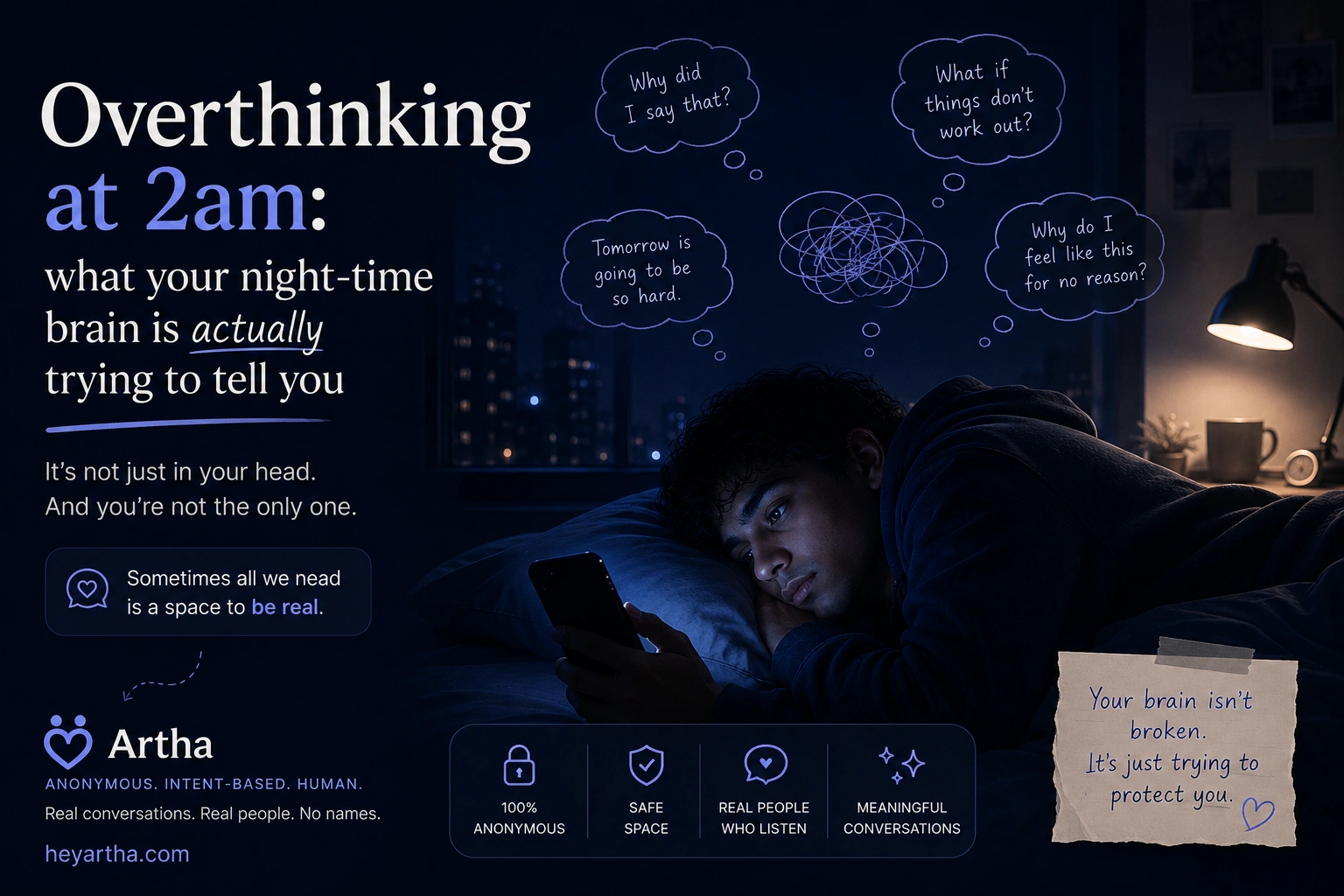
2:17am.
You're not really scrolling anymore. The phone is just there in your hand, screen going dim every few seconds because you keep forgetting to touch it. The room is quiet. Your head is not. You're replaying something from three days ago, or thinking about tomorrow, or thinking about nothing specific at all, just this low, restless hum that won't let you sleep.
Nobody's awake. And even if someone were, you're not sure what you'd say.
This kind of 2am overthinking in India is something most people know and almost nobody talks about out loud.
Why 2am makes everything feel bigger
There's something about the dark that drops all the pretence. During the day there's so much noise — classes, notifications, the group chat going off, deadlines, the general business of being alive. Your brain doesn't have space to sit with things properly. So it waits.
And when the lights go off and the corridor outside goes quiet, everything it's been carrying starts to surface.
In India, I think this gets heavier than people admit. A lot of us spend our days performing fine. Fine in class. Fine when Ma calls. Fine on the family WhatsApp group where everything is always okay. You hold it together for sixteen hours and then at 2am you're alone with the version of yourself that didn't get a turn to speak all day. If you've ever felt lonely but too scared to reach out to anyone around you, even people who care about you, this is probably a big part of why.
It's not weakness. It's just backlog.
What your brain is actually doing when thoughts won't stop
There's a part of the brain called the Default Mode Network. It's most active when you're not doing anything specific. It handles self-reflection, imagining other people's perspectives, mentally simulating future scenarios. It's also where a lot of anxiety tends to live.
When you lie down and stop distracting yourself, this network switches on hard. Your brain starts doing what it does best: trying to make sense of unresolved things. What did that person mean by that? What's going to happen in the exam? Is any of this going anywhere?
The problem isn't that your brain is broken. It's that it's trying to solve things that don't have clean answers yet, and the night gives it too much silence to work with.
Some of what it brings up is legitimate. Placement pressure. Semester results. The feeling of being behind, even when you can't exactly explain behind at what. An uncertain future that nobody in your family has a map for either. These are real things. They deserve real processing time.
But at 2am, your brain can't tell the difference between an actual problem and an imagined catastrophe. So it treats both the same way: keep running, never sleep.
What people usually try, and where it actually helps
Most people do one of three things when this happens. They scroll until they're numb. They lie there trying to force sleep and fail at it. Or they send something to a group chat that's already been silent for hours.
Journaling helps more people than expect it to. The act of putting a thought into words forces your brain to slow down, because you can't write as fast as you spiral. The act itself interrupts the loop a little. Not everyone can sit with it, but if you can get past the feeling of being self-conscious about writing to yourself at 2am, it's worth trying.
Meditation is real, but it takes practice before it actually does anything. 2am is not the moment to learn breathwork from scratch.
Talking to someone is usually the most effective thing. But people who know you come with history and context. When you tell your roommate about something you're anxious about, they already know everything else about your life. Sometimes that's comforting. Sometimes it makes everything more complicated, not less.
There's research suggesting that just voicing anxious thoughts to another person, even a stranger, reduces their intensity. Because the act of turning something vague into actual words already creates some distance from it. If you've ever told the truth about something to someone you'd never see again and felt lighter afterwards, you already know this works. There's a closer look at why in this piece on opening up to strangers online.
What might actually help tonight
Slow down the pace first. Not the thoughts, you can't stop those by trying. The pace.
Put the phone face-down. Lie still for two minutes. Not to fall asleep. Just to stop adding new input to a system that's already overloaded.
Then pick one thought. Not all of them. The loudest one. Stay with it for a moment, don't solve it, don't analyse it, just acknowledge it. Sometimes that's enough to take it from a spiral to just a thought you're having.
If you genuinely need somewhere to put what's in your head, anonymous conversation can help in a way that texting someone who knows you can't. Artha is built for nights when your thoughts need somewhere to go, matching you with someone who isn't going to remember it by morning. What that kind of conversation actually feels like is worth reading before you try it, and if you're wondering whether anonymous spaces are actually safe, here's an honest answer to that.
No pressure. But if the alternative is another hour of ceiling-staring, it's worth knowing it exists.
A note from the person who built this
I'm 18, originally from Singrauli, now in Indore preparing for CA. I had a lot of 2am nights where I wanted to talk but not to anyone who knew me. Not because the people around me aren't good people. They are. It's just that sometimes you don't want a conversation that comes with context and implications. You want to think out loud with someone. I looked for that and couldn't find it in a way that felt right. That's where Artha came from. It's still young and still growing. But it started here, at 2am, with thoughts that had nowhere to go.
The 2am brain isn't broken. It's kind of brilliant in a very inconvenient way. It waits until the day is done and everything is quiet, and then it brings out everything that didn't get processed when the lights were on. The problem isn't the thinking. Most of the time, it's just that you're doing it completely alone.
What's one thing your 2am brain keeps coming back to that you haven't been able to talk about with anyone yet?
Key References & External Resources
Quick answers
Things people usually want to know.
Why do I overthink so much at 2am?
Your brain's Default Mode Network, which handles self-reflection and future-thinking, becomes most active when external distractions disappear. At 2am, with the day's noise gone, it switches on fully and starts processing everything you didn't have time to sit with. It's not a flaw. It's just your brain doing its job in the only quiet window it gets.
Is it normal to be anxious and overthinking at night in India?
Very normal, and more common than people admit. The pressure of exams, placements, family expectations, and uncertain futures creates a lot of background stress. Many young adults in India spend the day performing fine and only face their actual feelings at night, alone.
How do I stop my mind from racing at night?
You can't directly stop your thoughts, but you can interrupt the pace. Put your phone face-down, lie still for two minutes, and then focus on just one thought instead of all of them at once. Journaling or talking to someone, even anonymously, can help break the loop.
Why does everything feel worse at 2am?
At night, your brain loses the daytime context that counterbalances anxious thoughts. Without those, a small worry can feel enormous. Sleep deprivation also affects the brain's ability to regulate emotion, which makes everything feel heavier than it probably is.
What should I do if I can't sleep because of overthinking?
Don't force sleep. Slow the input first: phone down, lie still, and pick just one thought to sit with rather than trying to manage all of them. If you need to talk it through, anonymous platforms let you do that without the social weight of reaching out to someone in your life at an odd hour.
Why do I get sad or anxious at night even when the day was fine?
Because the day being fine often means you were managing, not actually processing. Night removes the structure that keeps things at bay. Your brain isn't suddenly worse at night. It's just finally honest.
Is overthinking at night a sign of anxiety?
Occasional night-time overthinking is a normal response to stress. But if it's happening most nights, affecting your sleep significantly, or coming with physical symptoms like a racing heart or tightness in your chest, it might be worth talking to a mental health professional. Persistent patterns are worth paying attention to.
Does talking to a stranger actually help with overthinking?
Research suggests it can. Voicing anxious thoughts to another person, even someone you don't know, can reduce their intensity. Putting a vague feeling into words makes it more manageable. Anonymous conversations remove the social stakes that sometimes make talking to people you know feel more complicated than the problem itself.
What are some quick things to do when 2am thoughts won't stop?
Lengthen your exhales for a few breaths. Put your phone down. Pick one thought and acknowledge it rather than trying to push it away. Write a few sentences if you can. Or find somewhere to say what you're actually thinking, anonymously, without it following you into tomorrow.
Is there anyone to talk to late at night in India when I can't sleep?
Yes. Anonymous platforms like Artha connect you with someone for a real conversation based on what kind of connection you actually need, without profiles, history, or social consequences. There are also mental health helplines in India available at any hour, including iCall at 9152987821 (TISS) and the Vandrevala Foundation at 1860-2662-345.
More from Artha
Other things we've been writing about.
Feeling lonely but scared to reach out — what to actually do
Wanting connection but too scared to reach out isn't laziness — the fear is real. Here's why it happens, and the smallest first step you can take today.
Why It's Easier to Open Up to a Stranger Online
Telling a stranger online how you really feel is often easier than telling your closest friend. Here's the quiet psychology behind it — and why it's okay.
First Year College Loneliness India: You're Not the Only One
Everyone's hostel story looks like a movie. Yours feels different. The honest truth about first year college loneliness in India.