FRM vs CFA: Risk Specialisation or Markets Breadth?
November 30, 2026 · 10 min read · by Shivam Kushwaha, Artha founder
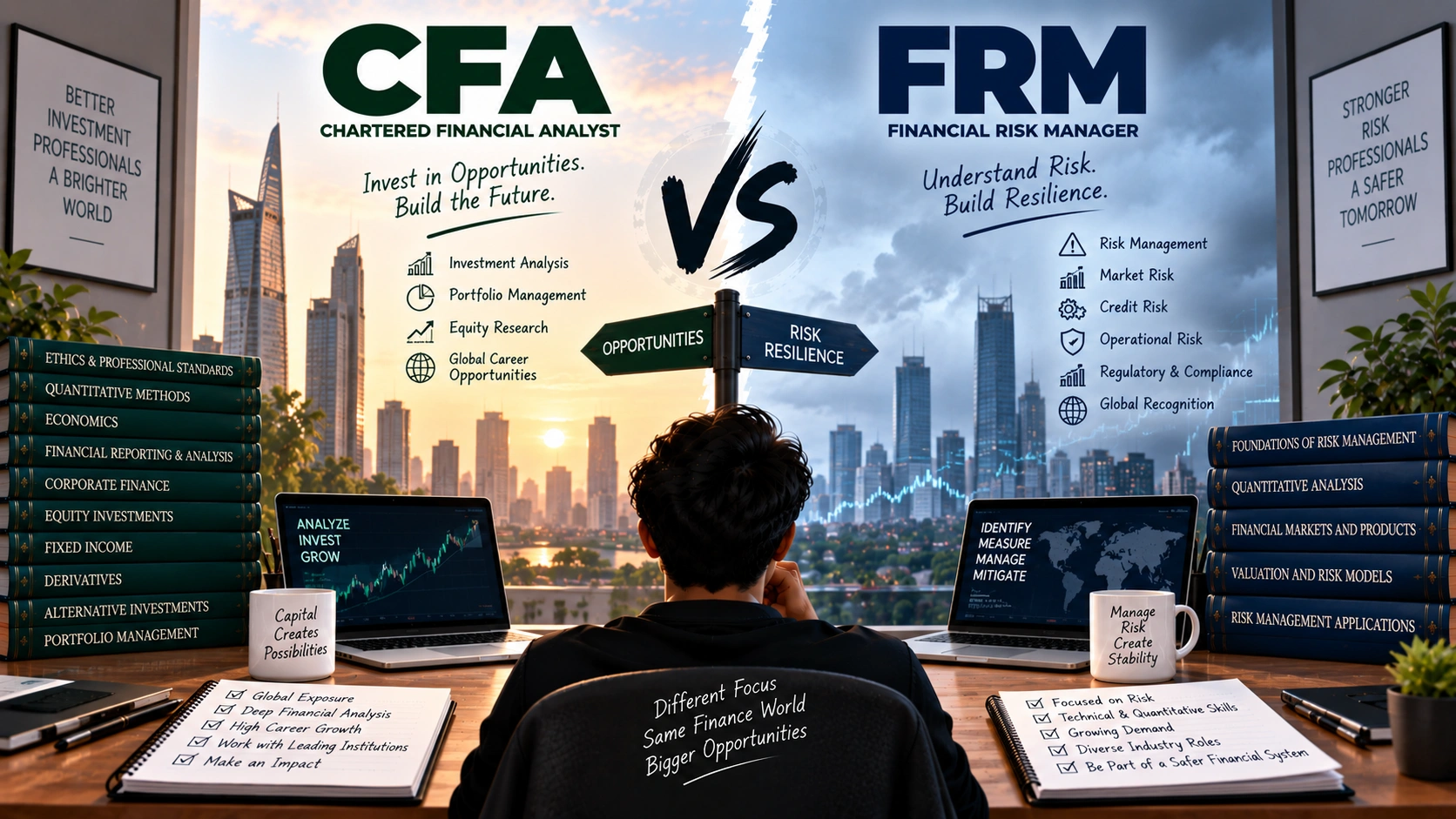
Someone in your batch is grinding through CFA Level II while you're prepping for FRM Part II, and everyone keeps asking which one you should have picked. Two completely different finance credentials, same career-pivot anxiety.
FRM is two exam parts from GARP focused specifically on financial risk management, typically completed in 1 to 2 years. CFA is three exam levels from CFA Institute covering broad investment analysis and portfolio management, typically taking 2 to 4 years. FRM goes deep into risk. CFA goes wide across markets. Comparing them directly misses what each one is actually built for.
The actual numbers, side by side
| FRM (GARP) | CFA (CFA Institute) | |
|---|---|---|
| Governing body | Global Association of Risk Professionals (GARP) | CFA Institute (US-headquartered, global) |
| Structure | 2 parts: Part I and Part II, each a separate exam | 3 levels: Level I, II, III, each a separate exam |
| Typical duration | 1 to 2 years | 2 to 4 years depending on pacing |
| Pass rate | Part I: 44% globally (May 2024, per GARP); Part II: 44% (May 2024, per GARP) | Level I: 39% of 31,566 candidates worldwide passed in May 2026, per CFA Institute |
| Work experience requirement | 2 years of professional experience in risk-related roles | 4,000 hours of professional experience in investment decision-making |
| Core focus | Market risk, credit risk, operational risk, liquidity risk, quantitative risk models, Basel regulations | Equity valuation, fixed income, derivatives, portfolio management, economics, financial reporting |
| Where it's valued most | Risk management, treasury, bank regulation, insurance, ALM roles globally | Portfolio management, equity research, asset management, investment banking roles globally |
What FRM is actually for
FRM was built for people whose job is understanding what can go wrong with money, how to measure it, and how to reduce it. The two-part structure is designed to take you from foundational risk concepts into specialised modelling of market, credit, and operational risk.
The Part I exam covers foundations of risk management, quantitative analysis, financial markets, and risk models. Part II goes deeper into market risk measurement, credit risk, operational risk, liquidity, and current risk management issues. The content is heavily quantitative and tied directly to how banks and regulators actually manage risk.
The real strength of FRM is that it's the credential the risk management industry specifically recognises. If you're targeting a risk function at a bank, insurance company, or regulator, FRM is the direct signal that you're trained for that exact work.
What CFA is actually for
CFA was built for a broader slice of the finance industry: analysing companies for investment decisions, pricing assets, and constructing portfolios. The three-level structure moves from foundational tools across economics, ethics, and financial reporting through equity valuation, derivatives, and portfolio construction.
CFA's breadth is both its strength and its limitation. It covers enough ground to be relevant across multiple finance roles, but it doesn't go deep enough in risk-specific modelling to substitute for FRM in a risk function.
The real strength of CFA is in roles where investment judgment is the actual job: equity research, portfolio management, and asset management. These roles frequently list the CFA charter as a requirement or strong preference.
Where people get this decision wrong
The most common mistake is treating FRM as a subset of CFA, assuming that CFA's broader coverage includes risk management. CFA covers risk concepts, but not at the depth or specificity that risk management roles require. It doesn't cover Basel regulation, credit risk modelling, or operational risk frameworks in any meaningful detail.
The reverse mistake shows up in people pursuing CFA because it's more well-known, even though their actual job target is a risk function at a bank. They end up with broad investment knowledge and still need to learn risk-specific material on the job.
A third pattern involves people assuming FRM is only useful at banks. Insurance companies, asset managers with risk functions, and regulators all hire FRM holders. The scope is wider than people think.
The actual decision
The real question isn't which credential is more respected overall. It's whether your actual career target involves managing and measuring risk, or whether it involves investment analysis and portfolio construction.
If you're picturing a risk function at a bank, insurance company, or regulator, where the daily work is measuring market exposure, modelling credit losses, or managing operational risk, FRM is the credential built for exactly that.
If instead you're picturing equity research, portfolio management, or asset management, where the daily work is analysing companies and constructing investment portfolios, CFA is built specifically for that.
Risk or markets, not better or worse
FRM and CFA aren't ranked against each other the way comparison articles make it look. One is a deep, specialised credential for people who manage financial risk. The other is a broad, widely recognised credential for people who make investment decisions.
Which problem do you actually want to solve, the one where something goes wrong with the money, or the one where you're deciding where to put it?
Quick answers
Things people usually want to know.
Which is harder, FRM or CFA?
They test different things. FRM Part II's global pass rate was 44% in May 2024 per GARP. CFA Institute reported a 39% Level I pass rate in May 2026. Difficulty depends on whether you find risk modelling or broad markets content more natural.
Can I do both FRM and CFA?
Yes, and some professionals do, especially in risk roles that require investment knowledge. But it's additional years of effort without a specific role that mandates both. Pick the one aligned to your actual job target first.
How long does FRM take compared to CFA?
FRM is two parts, each a separate exam, typically completed in 1 to 2 years. CFA has three levels and typically takes 2 to 4 years depending on pacing.
Is FRM recognised globally?
Yes. GARP's FRM is the most widely recognised credential specifically in financial risk management worldwide. Banks and regulators globally reference it in risk hiring.
What jobs require FRM specifically?
Risk management roles at banks, insurance companies, regulators, and treasury functions. Job titles include market risk analyst, credit risk manager, operational risk officer, and ALM specialist.
What jobs require CFA specifically?
Portfolio management, equity research, and asset management roles frequently list the CFA charter as a requirement or strong preference. Investment banking values it but doesn't always require it.
Does FRM give exemptions toward CFA?
No. There is no formal exemption structure between GARP and CFA Institute. Each credential must be completed independently.
Which pays more, FRM or CFA?
It depends on role, sector, and geography rather than the credential alone. Risk management roles at large banks pay well, but portfolio management and equity research roles at asset managers can pay more. The credential doesn't determine salary; the role does.
Should I do FRM if I want to work in a bank?
FRM is directly relevant if you're targeting a risk management function at a bank. If you're targeting a front-office or investment role at the same bank, CFA may be more relevant.
Is FRM enough for a risk management career?
Yes. FRM is the primary credential the risk management industry recognises. Combined with relevant experience, it's sufficient for most risk management roles without needing CFA.