FRM vs CA: Which One Actually Improves Your Odds? (2026)
December 10, 2026 · 10 min read · by Shivam Kushwaha, Artha founder
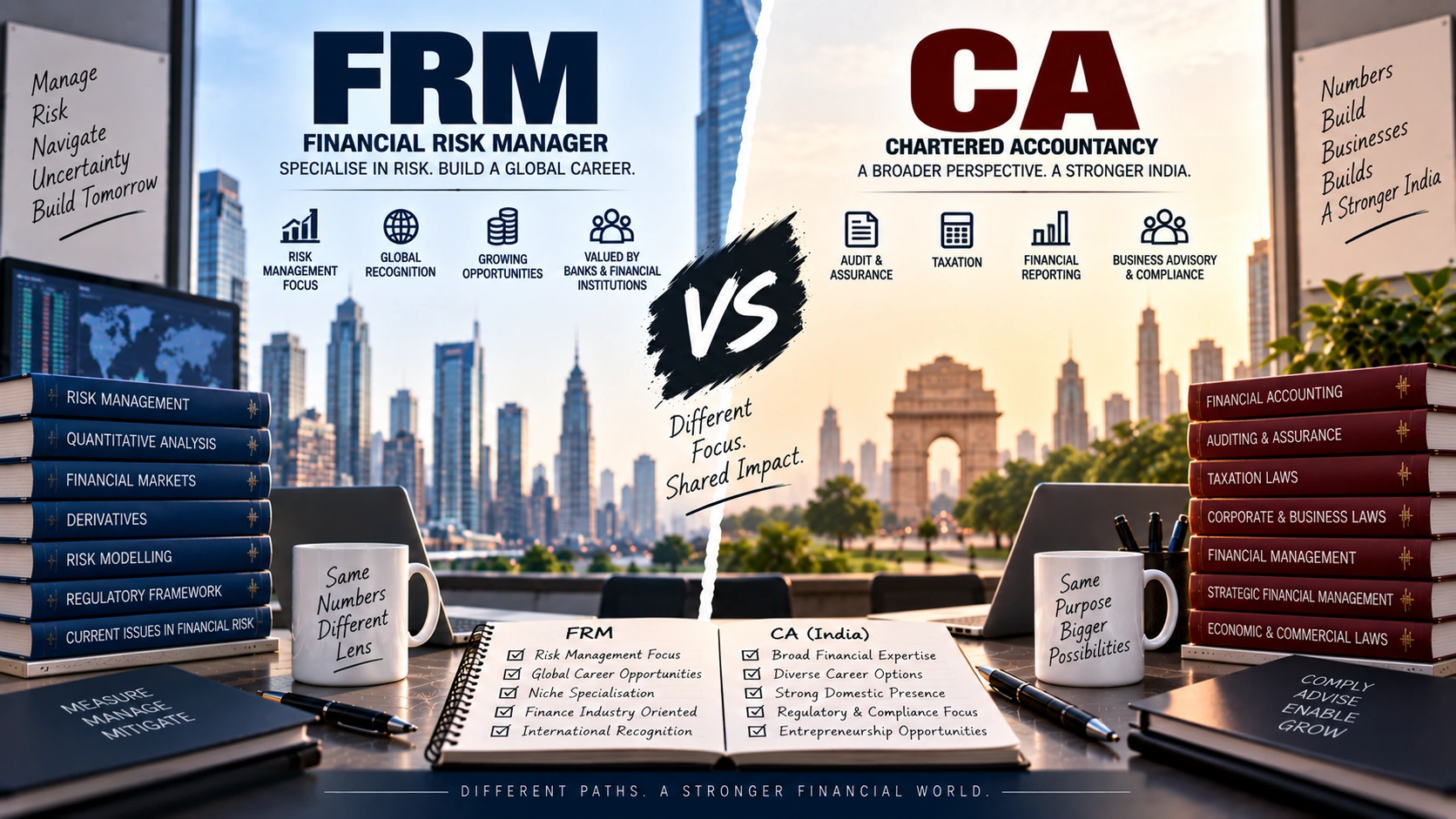
First-year articleship, already behind on the CA Final syllabus, and someone in the batch group is posting about GARP registration. CA is already underway. FRM is the one everyone keeps bringing up like it's the faster credential nobody told you about.
CA takes roughly 4.5 to 5 years including mandatory articleship and is the only credential that can sign a statutory audit report in India. FRM typically takes 1 to 2 years across two exam parts and is built around risk management in banking and financial services, with no audit-signing authority anywhere. Comparing them as if one simply beats the other misses what each one is actually for.
The actual numbers, side by side
| CA (ICAI) | FRM (GARP) | |
|---|---|---|
| Governing body | Institute of Chartered Accountants of India | Global Association of Risk Professionals (US-headquartered, global) |
| Structure | Foundation, Intermediate, 3-year Articleship, Final | 2 parts: Part I and Part II, each a separate exam |
| Typical duration | 4.5 to 5 years including articleship | 1 to 2 years depending on pacing |
| Pass rates | CA Final both-groups: 19.88% (May 2024); 13.44% (Nov 2024), per ICAI | Part I: 44% (May 2025); Part II: 56% (May 2025), per GARP |
| Statutory rights in India | Only CAs can sign statutory audit reports under the Companies Act | None at any level |
| Core focus | Audit, taxation, statutory compliance, financial reporting | Risk measurement, VaR modelling, stress testing, credit risk, regulatory capital |
| Where it's valued most | Indian statutory audit, tax practice, industry finance roles | Banking risk management, treasury, ALM, credit risk, market risk roles globally |
What CA is actually for
CA exists to protect a specific legal function: the authority to sign an Indian statutory audit report. Everything about the credential's structure, especially the three-year articleship, is built around making sure that authority is earned through actual practice.
The day-to-day texture of the CA path is grinding in a very particular way. Long hours during articleship, exam cycles stacked on top of ongoing client work, and a Final exam that historically passes well under a quarter of both-group attempters.
The real limitation is scope, not difficulty. CA's training is deeply rooted in Indian accounting standards, tax law, and statutory compliance. Someone aiming purely at risk modelling in banking will find that CA's curriculum doesn't actually cover the specific skill set those roles are built around.
What FRM is actually for
FRM was built for a completely different kind of finance work: measuring, modelling, and managing financial risk. The two-part structure moves from foundational risk tools — quantitative analysis,金融市场知识, risk management frameworks — toward increasingly specialised topics like credit risk modelling, market risk measurement, and regulatory capital computation.
FRM's real strength is in roles where risk judgment, not statutory compliance, is the actual job. Banking risk desks, treasury functions, ALM teams, and credit risk departments frequently either require or strongly prefer the credential.
The real limitation is that FRM grants zero statutory authority anywhere. It doesn't touch audit, tax filing, or any regulatory signature requirement.
Where people get this decision wrong
The most visible mistake is assuming FRM is simply "CA but for banking people," a faster or more modern alternative covering similar ground. It doesn't cover similar ground at all.
The reverse mistake shows up in people who commit to the full CA path assuming it's simply the more prestigious option, without checking whether their actual career goal is risk management or treasury work at a bank.
A third, quieter pattern involves people chasing the CA-plus-FRM combination purely because it sounds impressive on paper, without a specific role in mind that actually needs both.
The actual decision
The real question isn't which credential is harder or more respected in the abstract. It's whether your actual interest is in the legal, compliance-anchored work CA authorises, or the risk measurement and management work FRM is built around.
If you're picturing statutory audit, tax practice, or any role where ICAI's specific legal signing rights matter, CA is the credential built for exactly that, and FRM cannot substitute for it.
If instead you're picturing banking risk management, treasury, ALM, or credit risk modelling, where the actual daily work is measuring and stress-testing financial exposures rather than auditing financial statements, FRM is built specifically for that.
Different jobs, not different tiers
CA and FRM aren't really ranked against each other the way the search results make it look. One is a legal authority anchored in Indian statutory work. The other is a globally recognised risk credential anchored in banking and financial risk management.
Which room do you actually want to spend the next several years working inside, the audit and compliance side, or the risk and treasury side?
Quick answers
Things people usually want to know.
Which is better, FRM or CA, for a career in India?
Neither is universally better. CA carries statutory audit-signing authority under Indian law that FRM does not have. FRM is built around risk management in banking and financial services and carries global recognition in those specific fields. The right choice depends on whether you want compliance-anchored accounting work or risk-management work.
Can an FRM holder sign audit reports in India?
No. Only ICAI-qualified Chartered Accountants can sign statutory audit reports under Indian company law. FRM grants no audit or statutory signing authority anywhere.
How long does FRM take compared to CA?
FRM typically takes 1 to 2 years across two exam parts, depending on pacing and whether you sit both parts in the same window. CA takes roughly 4.5 to 5 years including the mandatory three-year articleship.
Is the FRM exam harder than CA Final?
They test different things. FRM Part I pass rates have generally run between 40 and 50 percent, and Part II between 50 and 60 percent in recent GARP windows. CA Final's both-groups pass rate has historically ranged between roughly 13 and 20 percent. Difficulty is subjective and depends on your background.
Should I do CA and FRM together?
Some professionals do, particularly CAs moving into risk management or treasury roles at banks. It's a genuinely strong combination for that specific transition, but doing both without a clear target role adds years without a clear payoff.
Does CA give any exemptions toward FRM?
No formal exemption structure exists between ICAI and GARP. Every FRM candidate, including qualified CAs, must sit and pass both parts independently.
Which pays more, FRM or CA, in India?
It depends heavily on role and sector rather than credential alone. CAs in statutory audit, tax practice, and industry finance roles have well-documented salary ranges. FRM holders in banking risk, treasury, and ALM roles tend to command competitive packages, but no centralised Indian dataset tracks FRM-specific compensation.
Is FRM recognised in India?
Yes, particularly in banking risk management, treasury, credit risk, market risk, and ALM roles at Indian and multinational banks and financial institutions. It is not recognised as a substitute for CA in any statutory context.
What kind of work does a CA actually do that an FRM doesn't?
Statutory audits, tax filings, financial reporting under Indian accounting standards, and compliance work — all of which require the specific legal authority only ICAI-qualified CAs hold.
What kind of work does an FRM actually do that a CA doesn't?
Risk measurement, VaR modelling, stress testing, credit risk analysis, and regulatory capital computation are the core of FRM's curriculum in a depth CA's syllabus doesn't reach.