FRM vs ACCA: Risk Credential or Global Accounting Credential? (2026)
December 11, 2026 · 9 min read · by Shivam Kushwaha, Artha founder
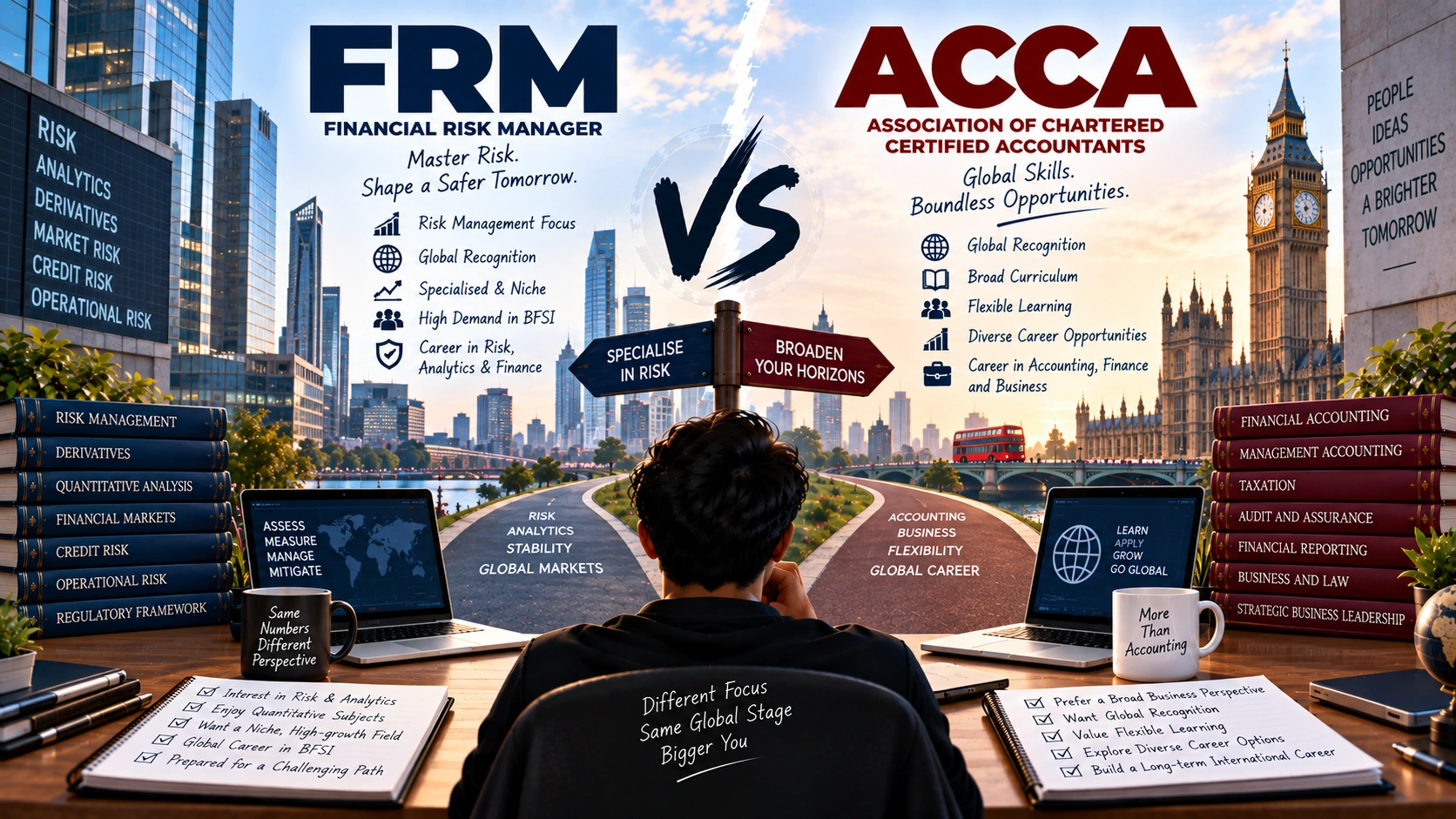
Midway through an ACCA paper cycle, comfortable with financial reporting and management accounting, and someone mentions GARP's FRM programme. ACCA is already the plan. FRM is the alternative everyone keeps framing as the more "risk-relevant" credential.
ACCA typically takes 2 to 3 years across 13 papers and is built around broad accounting, tax, and financial management skills recognised globally. FRM typically takes 1 to 2 years across two exam parts and is built around financial risk management in banking and financial services. Comparing them as if one replaces the other misses what each one is actually for.
The actual numbers, side by side
| ACCA (ACCA Global) | FRM (GARP) | |
|---|---|---|
| Governing body | Association of Chartered Certified Accountants (UK-headquartered, global) | Global Association of Risk Professionals (US-headquartered, global) |
| Structure | 13 papers across Applied Knowledge, Applied Skills, Strategic Professional, plus 3 years of practical experience requirement | 2 parts: Part I and Part II, each a separate exam |
| Typical duration | 2 to 3 years depending on exemptions and pacing | 1 to 2 years depending on pacing |
| Exam pass rates | Individual paper pass rates generally range between 40 and 55 percent across recent sittings, per ACCA Global | Part I: 44% (May 2025); Part II: 56% (May 2025), per GARP |
| Statutory rights in India | No statutory audit-signing authority in India | None at any level |
| Core focus | Financial reporting (IFRS), management accounting, audit, tax, financial management | Risk measurement, VaR modelling, stress testing, credit risk, regulatory capital |
| Where it's valued most | Multinational companies, shared services, international accounting firms, global financial reporting roles | Banking risk management, treasury, ALM, credit risk, market risk roles globally |
| Global footprint | Recognised in over 180 countries; audit rights in select jurisdictions with mutual recognition | Recognised globally in banking risk, treasury, and financial risk roles |
What ACCA is actually for
ACCA exists to produce accountants with global breadth. The 13-paper structure covers financial reporting under IFRS, management accounting, audit processes, taxation, and financial management, all designed to be transferable across countries and industries.
The day-to-day texture of the ACCA path is steady and broad. Multiple exam sittings per year, a practical experience requirement that ensures real-world exposure, and a curriculum designed to make you versatile across accounting and finance functions rather than deep in one narrow specialism.
The real limitation is depth, not breadth. ACCA gives you a solid foundation across accounting and finance, but it doesn't go deep into risk modelling, VaR computation, or stress testing. Someone aiming purely at banking risk management will find ACCA's curriculum doesn't cover the specific quantitative tools those roles demand.
What FRM is actually for
FRM was built for a completely different kind of finance work: measuring, modelling, and managing financial risk. The two-part structure moves from foundational risk tools — quantitative analysis, financial markets knowledge, risk management frameworks — toward increasingly specialised topics like credit risk modelling, market risk measurement, and regulatory capital computation.
FRM's real strength is in roles where risk judgment, not accounting breadth, is the actual job. Banking risk desks, treasury functions, ALM teams, and credit risk departments frequently either require or strongly prefer the credential.
The real limitation is that FRM is narrow by design. It goes deep into risk management but doesn't cover the accounting, tax, and financial management breadth that ACCA provides. Someone wanting a generalist accounting credential will find FRM too specialised.
Where people get this decision wrong
The most visible mistake is assuming FRM is simply "ACCA but for banking people," a narrower alternative covering similar ground. It doesn't cover similar ground at all.
The reverse mistake shows up in people who commit to the ACCA path assuming it's the more universally applicable option, without checking whether their actual career goal is risk management or treasury work at a bank.
A third, quieter pattern involves people chasing the ACCA-plus-FRM combination purely because it sounds impressive on paper, without a specific role in mind that actually needs both.
The actual decision
The real question isn't which credential is harder or more respected in the abstract. It's whether your actual interest is in the broad accounting and financial management work ACCA covers, or the specialised risk measurement and management work FRM is built around.
If you're picturing financial reporting under IFRS, management accounting, or any role where broad accounting versatility across countries matters, ACCA is the credential built for exactly that, and FRM cannot substitute for it.
If instead you're picturing banking risk management, treasury, ALM, or credit risk modelling, where the actual daily work is measuring and stress-testing financial exposures rather than preparing financial statements, FRM is built specifically for that.
Different jobs, not different tiers
ACCA and FRM aren't really ranked against each other the way the search results make it look. One is a broad, globally recognised accounting credential. The other is a deep, globally recognised risk credential.
Which room do you actually want to spend the next several years working inside, the broad accounting and finance side, or the specialised risk and treasury side?
Quick answers
Things people usually want to know.
Which is better, FRM or ACCA, for a career in India?
Neither is universally better. ACCA provides broad accounting and financial management credentials recognised in over 180 countries. FRM provides deep specialisation in financial risk management. The right choice depends on whether you want global accounting breadth or risk-management depth.
Can an ACCA member sign audit reports in India?
No. In India, only ICAI-qualified Chartered Accountants can sign statutory audit reports under Indian company law. ACCA does not grant statutory audit-signing authority in India, though it may carry audit rights in certain other jurisdictions where ACCA has mutual recognition agreements.
How long does FRM take compared to ACCA?
FRM typically takes 1 to 2 years across two exam parts. ACCA typically takes 2 to 3 years across 13 papers, depending on exemptions and pacing.
Is the FRM exam harder than ACCA?
They test different domains. FRM focuses exclusively on risk management and financial risk modelling. ACCA covers a broad range of accounting, tax, audit, and financial management topics. Difficulty is subjective and depends on your background and interest area.
Should I do ACCA and FRM together?
Some professionals do, particularly those in banking who want both accounting breadth and risk specialisation. It's a strong combination for roles in bank financial reporting or regulatory reporting, but doing both without a clear target role adds years without a clear payoff.
Does ACCA give any exemptions toward FRM?
No formal exemption structure exists between ACCA and GARP. Every FRM candidate, including qualified ACCA members, must sit and pass both parts independently.
Which pays more, FRM or ACCA, in India?
It depends heavily on role and sector. ACCA members in accounting, audit, and financial management roles have varying compensation ranges. FRM holders in banking risk, treasury, and ALM roles tend to command competitive packages. No centralised Indian dataset compares ACCA and FRM-specific compensation directly.
Is ACCA recognised in India?
Yes, particularly in multinational companies, shared services centres, and firms with international reporting requirements. ACCA does not carry statutory audit-signing authority in India, unlike ICAI CA.
What kind of work does an ACCA member actually do that an FRM holder doesn't?
Financial reporting under IFRS, management accounting, tax computation, and broad-based financial management across industries — all areas where accounting breadth, not risk specialisation, is the core requirement.
What kind of work does an FRM holder actually do that an ACCA member doesn't?
Risk measurement, VaR modelling, stress testing, credit risk analysis, and regulatory capital computation are the core of FRM's curriculum in a depth ACCA's syllabus doesn't reach.