CS vs CMA (India): Governance Authority vs Cost Authority
November 17, 2026 · 9 min read · by Shivam Kushwaha, Artha founder
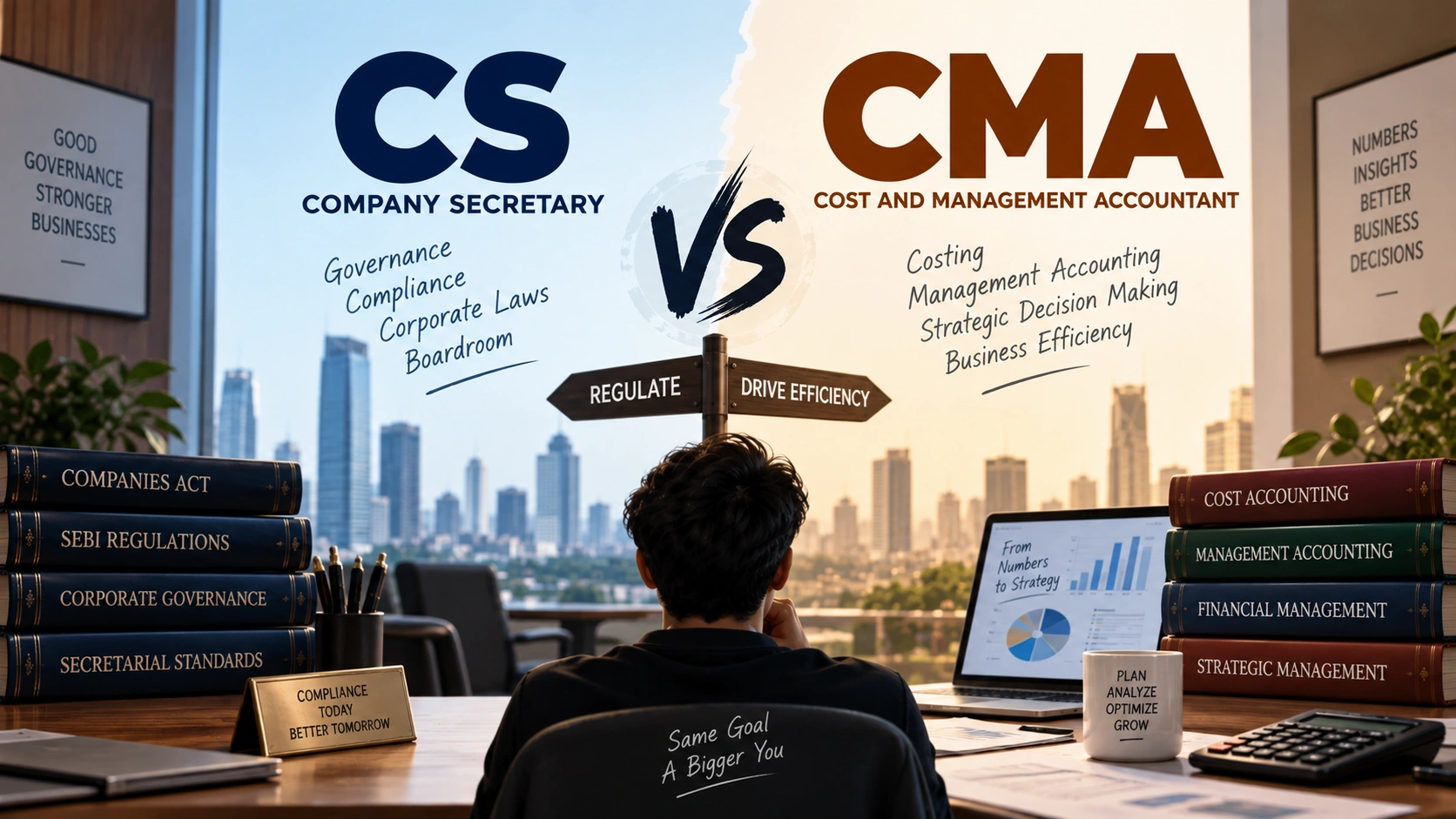
Cost sheets spread across the desk, variance reports demanding explanation, and a production manager asking why the budget blew out again. Meanwhile, in the next cabin, someone is reviewing board meeting agendas and drafting minutes for the quarterly compliance filing. Two completely different jobs, two completely different credentials, and a surprisingly common question: which one should I pick.
CS is externally focused governance work: board minutes, regulatory filings, and compliance under the Companies Act and SEBI LODR. CMA is internally focused cost accounting work: cost sheets, variance analysis, budgeting, and cost audit authority under the Companies Act. They serve different functions in a company's structure, and comparing them requires understanding what each role actually does on a daily basis.
The actual numbers, side by side
| CS (ICSI) | CMA (ICMAI) | |
|---|---|---|
| Governing body | Institute of Company Secretaries of India | Institute of Cost Accountants of India |
| Structure | Foundation, Executive, Professional | Foundation, Intermediate, Practical Training, Final |
| Typical duration | 3 to 4 years | 3 to 4 years |
| Pass rates | Roughly 20 to 25 percent at Professional level (ICSI publishes less consistently) | Roughly 15 to 20 percent at Final level (varies by session) |
| Statutory rights in India | Governance and secretarial authority under Companies Act and SEBI LODR | Cost audit authority under the Companies Act |
| Core focus | Corporate governance, regulatory compliance, secretarial practice | Cost accounting, budgeting, variance analysis, cost audit |
| Where it's valued most | Listed companies, banking, insurance, corporate governance roles | Manufacturing, cost audit, internal finance, operational roles |
What CS is actually for
CS fills a specific legal role in Indian corporate governance. The Company Secretary is the designated officer responsible for ensuring companies comply with board meeting requirements, regulatory filings with the Registrar of Companies, and SEBI's Listing Obligations and Disclosure Requirements for listed companies.
The daily work is procedural and compliance-oriented. Board meeting coordination, minutes drafting, annual return filings, share transfer management, and secretarial audits make up the substance of a CS professional's routine.
The real strength is governance authority. In listed companies, the CS holds a statutory position that no other credential can substitute. The Companies Act and SEBI regulations specifically designate certain functions to the Company Secretary, and that authority is legally non-transferable.
What CMA is actually for
CMA fills a different legal role: cost audit authority under the Companies Act. The Cost and Management Accountant is responsible for preparing cost audit reports, analysing production costs, and ensuring that cost accounting records comply with statutory requirements.
The daily work is numerical and analytical. Cost sheets, variance analysis, budgeting, standard costing, and financial modelling form the core of a CMA professional's routine. The work faces inward, toward the company's operations and management, rather than outward toward regulators and shareholders.
The real strength is cost authority. Under the Companies Act, certain classes of companies are required to conduct cost audits, and only ICMAI-qualified CMAs are authorised to perform this function. That statutory cost audit authority is the core of CMA's professional identity.
Daily work: where the difference becomes real
This is where the comparison stops being abstract. A CS professional's typical week involves coordinating board meetings, reviewing compliance calendars, preparing regulatory filings, and liaising with the Registrar of Companies. The work is relationship-heavy and deadline-driven, with regulatory authorities as the primary stakeholders.
A CMA professional's typical week involves preparing cost sheets, analysing budget variances, supporting pricing decisions, and maintaining cost accounting records. The work is data-heavy and analytical, with internal management as the primary stakeholders.
One faces outward. The other faces inward. Neither is more or less important; they serve different functions in the same corporate structure.
Difficulty and timeline
Both credentials take roughly 3 to 4 years from registration to qualification. CS's timeline is driven entirely by exam preparation and study, as there is no mandatory articleship in the structured CA sense. CMA's timeline includes a practical training requirement, which adds a supervised practice component that CS lacks.
Pass rates for both are demanding. CS Professional pass rates hover around 20 to 25 percent, while CMA Final pass rates tend to run between 15 and 20 percent depending on the session. CMA's pass rates are generally slightly lower, but the difference isn't dramatic enough to be the deciding factor.
Neither credential is easy. Both require sustained effort across multiple exam stages, and the daily work each leads to demands different kinds of analytical thinking.
Where the money actually goes
Fresher salary data for both credentials falls in a broadly similar range. CS graduates sourced through ICSI's placement channels typically land around 4 to 7 LPA. CMA graduates tend to start in a similar band, roughly 4 to 7 LPA, depending on employer and industry.
The salary trajectories diverge with experience. Senior CS professionals in listed company governance roles, particularly in banking and insurance, can command significant packages. Senior CMA professionals in manufacturing and cost audit roles similarly grow into higher compensation bands. The gap between the two narrows substantially after the first five to seven years of experience.
Where people get this decision wrong
The most visible mistake is assuming CMA is simply "CS but with numbers." It's not. CS and CMA grant different statutory authorities and lead to different career paths. One isn't a subset or variation of the other.
The reverse mistake shows up in people who choose CS because it sounds more corporate, without checking whether the actual governance and compliance daily work interests them. The procedural nature of CS work isn't for everyone.
A third pattern involves people picking CMA purely because cost accounting sounds more quantitative, without considering whether the statutory cost audit function is actually what they want to specialise in.
The real question
The question isn't which credential is easier or more marketable. It's whether your actual interest is in the governance and compliance work CS authorises, or the cost accounting and internal finance work CMA is built around.
If you're picturing board meeting coordination, regulatory filings, listed company compliance, or secretarial practice, where the actual daily work is governance-focused and externally oriented, CS is the credential built for exactly that.
If instead you're picturing cost sheets, variance analysis, budgeting, cost audit, or any role where analytical and numerical work drives decision-making, CMA is built specifically for that.
Different functions, not different levels
CS and CMA aren't really competing against each other the way the comparison posts suggest. One is a governance authority anchored in corporate law compliance. The other is a cost authority anchored in operational finance and statutory cost audit.
Which direction does your actual interest face, outward toward regulators and shareholders, or inward toward operations and management?
Quick answers
Things people usually want to know.
Which is better, CS or CMA, in India?
Neither is universally better. CS grants governance and secretarial authority under the Companies Act and SEBI LODR regulations. CMA grants cost audit authority under the Companies Act. The right choice depends on whether you want external-facing governance work or internal-facing cost accounting work.
Is CMA Indian or US?
Both exist. CMA (India) is administered by the Institute of Cost Accountants of India (ICMAI) and is a domestic Indian credential. US CMA is administered by IMA (Institute of Management Accountants) and is a global credential focused on management accounting. They are entirely separate qualifications with different curricula and authorities.
What is the main difference between CS and CMA?
CS is externally focused: board governance, regulatory filings, compliance with corporate law. CMA is internally focused: cost accounting, budgeting, variance analysis, and cost audit. One faces outward toward regulators and shareholders; the other faces inward toward operations and management.
Which pays more, CS or CMA?
Fresher salaries for both credentials tend to fall in a similar range, roughly 4 to 7 LPA depending on employer and industry. Senior professionals in either field can command significantly higher packages, with the gap closing substantially after 5 to 7 years of experience.
Can a CA get exemptions in CMA?
ICAI and ICMAI have some mutual recognition provisions, but exemptions are limited and depend on specific qualification stages. A qualified CA may get relief at certain CMA Intermediate levels, but must still complete the CMA Final examination. Check the latest ICMAI exemption circular for current details.
Can I do both CS and CMA together?
Technically yes, and some professionals pursue both credentials. There is meaningful overlap in corporate law and accounting content, but the two paths have distinct exam structures. Pursuing both extends your overall timeline unless you strategically overlap study periods.
Which is better for someone who likes numbers and analysis?
CMA is the more natural fit. Cost accounting, variance analysis, budgeting, and financial modelling are core to CMA's curriculum in a way that CS's governance-focused syllabus doesn't replicate.
Which is better for someone who likes law and governance?
CS is the more natural fit. Board meeting procedures, regulatory filings, compliance frameworks, and secretarial audits are the daily substance of CS work, and the curriculum is built around corporate law.
Does CMA have more scope than CS?
Scope depends on industry. CMA has strong demand in manufacturing, cost audit, and internal finance roles. CS has strong demand in listed companies, banking, insurance, and any regulated industry requiring governance compliance. Neither has universally more scope; it depends on which sector you're targeting.
Should I choose based on market perception?
Market perception is a noisy signal. Both credentials have legitimate demand in their respective domains. Base your decision on the actual daily work each credential leads to, not on which one your relatives have heard of.