CMA vs MBA Finance: Budget Control, Big-Money Role, or Overpaying? (2026)
December 2, 2026 · 9 min read · by Shivam Kushwaha, Artha founder
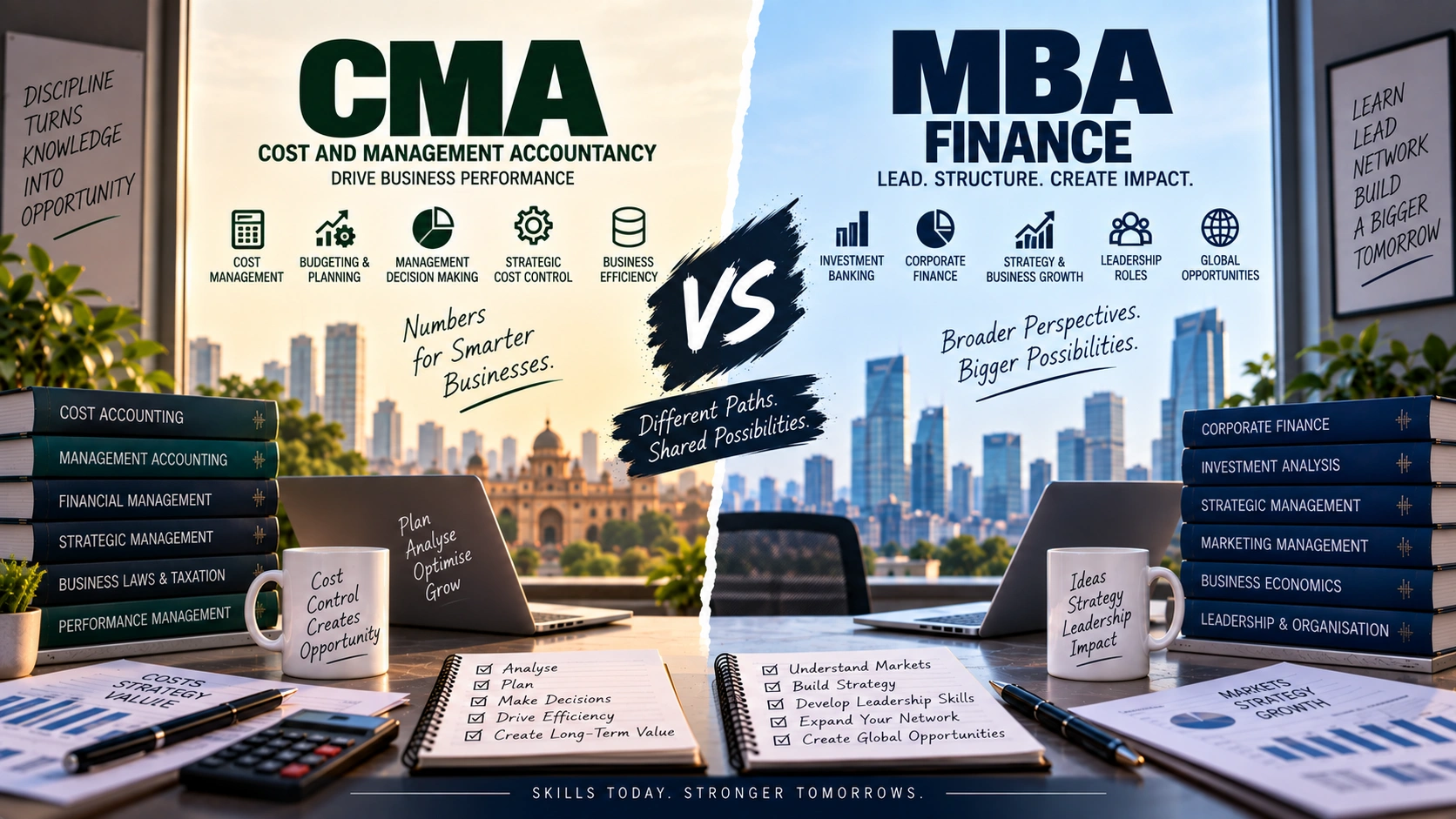
You're looking at MBA brochures with placement stats that look great, then checking your bank balance, and someone mentions CMA as an alternative. Same career goal, completely different price tag.
CMA takes 1 to 2 years, costs a fraction of an MBA, and builds deep skills in cost and management accounting, but offers no placement guarantee. MBA Finance is a 2-year program that costs significantly more but provides structured placement at top programs and a broader management curriculum. MBA wins on speed and placement certainty. CMA wins on cost efficiency and technical focus.
The actual numbers, side by side
| CMA (IMA) | MBA Finance (top-tier program) | |
|---|---|---|
| Structure | 2 parts: Part 1 (Financial Planning, Performance, and Analytics) and Part 2 (Strategic Financial Management) | 2-year full-time program with coursework, projects, and placement |
| Typical duration | 1 to 2 years depending on pacing | 2 years |
| Cost | Approximately $1,000 to $3,000 total including IMA membership, exam fees, and study materials | $30,000 to $80,000+ depending on program and country |
| Pass rate | Part 1: 45% globally (2023, per IMA); Part 2: 52% (2023, per IMA) | N/A; admission is competitive but ongoing assessment replaces exam gates |
| Placement | None. You find your own job. | Structured placement at top programs; summer internships convert to offers |
| Core focus | Cost accounting, budgeting, financial planning, internal controls, strategic decision-making | Corporate finance, financial management, strategy, broader management curriculum |
| Where it's valued most | Manufacturing, corporate finance, cost accounting, internal finance roles globally | Corporate finance, consulting, investment banking, management roles at larger firms |
What CMA is actually for
CMA was built for people whose work revolves around internal financial decision-making: budgeting, cost analysis, performance measurement, and strategic planning. The two-part structure covers financial planning and analytics in Part 1, and strategic financial management in Part 2.
The real strength of CMA is that it's directly relevant to the work that drives profitability inside a company. Cost accountants, financial planners, and management accountants use this skill set daily. The credential is recognised globally, particularly in manufacturing, consulting, and corporate finance.
The real limitation is placement. CMA gives you the skills and the credential, but it doesn't connect you to a job. You build your career through experience, networking, and individual effort. The path to senior roles is real but slower and less predictable than MBA placement from a target school.
What MBA Finance is actually for
MBA Finance, at a top-tier program, was built to do two things: broaden your management skills and give you a structured path into competitive finance and management roles. The placement pipeline is the primary product.
Summer internships at banks, consulting firms, and corporations convert to full-time offers. The school's recruiting relationships create access that's nearly impossible to replicate from outside the system.
The real strength of MBA is speed and placement certainty. A 2-year program can land you in corporate finance, consulting, or banking with a structured offer. The real limitation is cost, and the fact that the placement advantage is heavily tier-dependent. A top-20 MBA delivers outcomes that a lower-ranked program may not.
Where people get this decision wrong
The most visible mistake is assuming MBA is automatically worth the investment regardless of the school. The cost is similar across tiers, but the placement outcomes are dramatically different. A mid-tier MBA can leave you with significant debt and no placement advantage.
The reverse mistake shows up in people choosing CMA purely because it's cheaper, without recognising that the lack of placement means a longer, less certain path to the same roles.
A third pattern involves people assuming CMA is "just accounting," without realising that cost and management accounting is the backbone of internal financial decision-making at any large company.
The actual decision
The real question is whether you need a placement pipeline and broad management skills, or whether you need cost and management accounting depth at a low cost.
If you can access a top-20 MBA program, the structured placement and network typically justify the cost for corporate finance, consulting, or management roles. MBA gets you to the door faster.
If your target is cost accounting, budgeting, or internal finance roles, CMA provides the specific technical depth those roles need, at a fraction of the cost, but you build your own path.
If a top-tier MBA isn't accessible financially, CMA combined with relevant experience is a legitimate path to finance leadership roles, even if it takes longer.
Speed or efficiency, pick the actual constraint
MBA gets you the offer faster. CMA gets you the skills cheaper. Neither is universally better. The one that works is the one that solves the actual problem you're facing, not the one with the fancier brochure.
Quick answers
Things people usually want to know.
Which is better, CMA or MBA Finance?
Neither is universally better. CMA is low-cost and focused on cost and management accounting. MBA Finance is expensive but offers structured placement at top programs. The right choice depends on your budget, timeline, and target role.
How long does CMA take compared to MBA?
CMA typically takes 1 to 2 years depending on the level and attempt pace. MBA Finance is a 2-year full-time program.
Is CMA cheaper than MBA?
Significantly. CMA exam fees and study materials cost a fraction of MBA tuition. MBA at a top program can cost $30,000 to $80,000+ depending on the country.
Does MBA give better placement than CMA?
Yes. Top MBA programs have structured placement pipelines into corporate finance, consulting, and banking. CMA has no placement mechanism.
Can I get a big-money role with just CMA?
Yes, but it typically takes longer. CMA holders reach CFO and finance leadership roles, but the path is more dependent on individual experience and networking than on structured placement.
Is CMA recognised globally?
Yes, particularly in cost and management accounting. IMA's CMA credential is recognised across manufacturing, consulting, and corporate finance sectors globally.
Do companies prefer CMA or MBA for finance roles?
It depends on the role. Cost accounting, budgeting, and internal finance roles often value CFA. MBA is preferred for corporate finance, strategy, and management roles at larger firms. Some roles value both.
Can I do both CMA and MBA?
Yes, and some professionals do. MBA for placement and breadth, CMA for technical depth in cost and management accounting. But it's not required for most career paths.
Is MBA worth the cost if I'm already in a finance role?
If you're targeting senior management or pivoting to a different finance function, MBA can accelerate that transition. If you're already on a clear upward path in cost accounting, CMA may be sufficient.
Should I choose CMA if I can't afford a top MBA?
CMA is a strong, low-cost credential that builds real skills. If a top MBA isn't accessible financially, CMA combined with relevant experience is a legitimate path to finance leadership roles.