CFA vs FRM: Day-to-Day Work You're Actually Signing Up For
December 15, 2026 · 10 min read · by Shivam Kushwaha, Artha founder
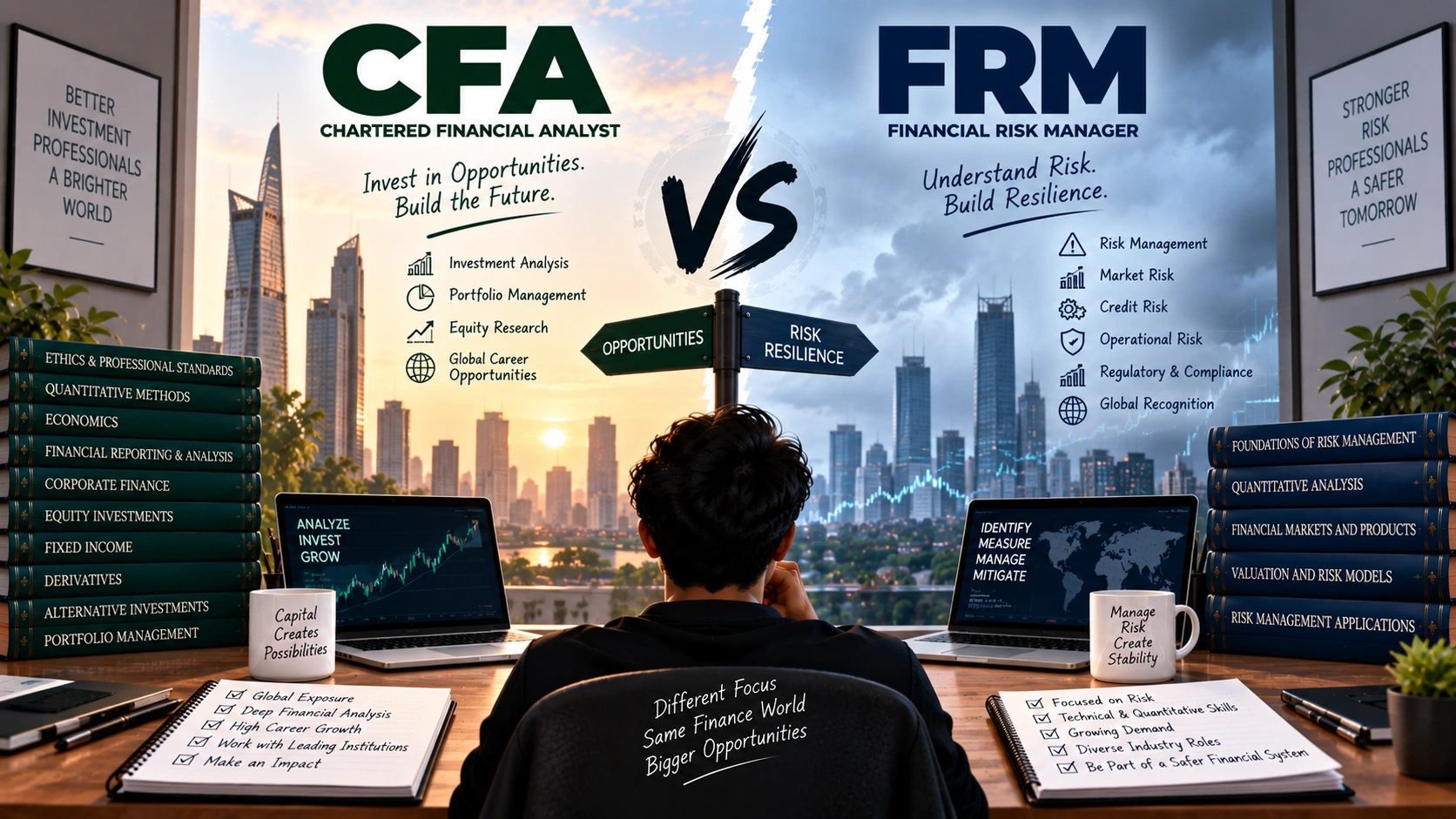
CFA Level II results just came out, the pass rate did its usual thing, and someone in the study group is asking whether FRM Part I is worth sitting alongside it. CFA is the long-term plan. FRM is the credential people keep describing as the "more practical" option for anyone heading into markets.
CFA typically takes 2 to 4 years across three exam levels and is built around portfolio management, equity research, and investment analysis. FRM typically takes 1 to 2 years across two exam parts and is built around risk measurement and risk management in banking and financial services. The exams aren't interchangeable, and the jobs they lead to are even less so.
The actual numbers, side by side
| CFA (CFA Institute) | FRM (GARP) | |
|---|---|---|
| Governing body | CFA Institute (US-headquartered, global) | Global Association of Risk Professionals (US-headquartered, global) |
| Structure | 3 levels: Level I, II, III, each a separate exam | 2 parts: Part I and Part II, each a separate exam |
| Typical duration | 2 to 4 years depending on pacing and deferrals | 1 to 2 years depending on pacing |
| Pass rates | Level I: 39% of 31,566 candidates worldwide passed in May 2026, per CFA Institute | Part I: 44% (May 2025); Part II: 56% (May 2025), per GARP |
| Signing authority | None | None |
| Core focus | Investment analysis, portfolio management, equity valuation, derivatives, fixed income | Risk measurement, VaR modelling, stress testing, credit risk, regulatory capital |
| Where it's valued most | Asset management, equity research, investment banking, portfolio management roles globally | Banking risk management, treasury, ALM, credit risk, market risk roles globally |
| Daily work centre | Making investment decisions and communicating theses | Measuring, modelling, and managing financial risk |
What CFA is actually for
CFA was built for people who make investment decisions. The three-level structure moves from foundational tools — quantitative methods, economics, financial reporting — toward increasingly specialised asset valuation, portfolio management, and behavioural finance content.
The day-to-day work of a CFA charter holder is reading company filings, building valuation models, debating investment theses with portfolio managers, and presenting stock pitches to investment committees. The texture is analytical but ultimately judgment-driven: you're making calls about what to buy, hold, or sell, and defending those calls with research.
CFA's real strength is in roles where investment judgment is the actual job. Equity research desks, asset management firms, and portfolio management roles frequently either require or strongly prefer the charter.
The real limitation is that CFA doesn't go deep into risk modelling. Portfolio risk is covered, but VaR computation, stress testing, and regulatory capital modelling aren't CFA's core territory.
What FRM is actually for
FRM was built for people who measure and manage risk. The two-part structure moves from foundational risk tools — quantitative analysis, financial markets knowledge, risk management frameworks — toward increasingly specialised topics like credit risk modelling, market risk measurement, and regulatory capital computation.
The day-to-day work of an FRM holder is monitoring risk limits, running VaR and stress-test models, writing risk reports for senior management and regulators, and analysing portfolio risk exposures across trading desks. The texture is quantitative and systematic: you're measuring how much risk the firm is taking, whether it's within limits, and what happens under stress scenarios.
FRM's real strength is in roles where risk measurement and management, not investment judgment, is the actual job. Banking risk desks, treasury functions, ALM teams, and credit risk departments frequently either require or strongly prefer the credential.
The real limitation is that FRM doesn't cover investment analysis or portfolio construction. Someone wanting to make investment decisions rather than measure the risk of those decisions will find FRM's curriculum doesn't build toward that.
Where people get this decision wrong
The most visible mistake is assuming FRM is simply "CFA but for risk people," a narrower alternative covering similar ground. It doesn't cover similar ground at all. CFA is about investment judgment; FRM is about risk measurement. They're adjacent but fundamentally different skill sets.
The reverse mistake shows up in people who commit to the full CFA path assuming it's the more prestigious option, without checking whether their actual career goal is risk modelling or treasury work at a bank.
A third, quieter pattern involves people chasing the CFA-plus-FRM combination purely because it sounds impressive on paper, without a specific role in mind that actually needs both. Portfolio risk roles are the main exception where both genuinely matter.
The actual decision
The real question isn't which credential is harder or more respected in the abstract. It's whether your actual interest is in the investment analysis and portfolio work CFA covers, or the risk measurement and management work FRM is built around.
If you're picturing equity research, asset management, or portfolio construction, where the actual daily work is analysing and pricing investments and defending investment theses, CFA is built specifically for that.
If instead you're picturing banking risk management, treasury, ALM, or credit risk modelling, where the actual daily work is measuring and stress-testing financial exposures and writing risk reports, FRM is built specifically for that.
Different jobs, not different tiers
CFA and FRM aren't really ranked against each other the way the search results make it look. One is an investment-judgment credential. The other is a risk-measurement credential. They lead to adjacent but different rooms in the same building.
Which room do you actually want to spend the next several years working inside, the portfolio and investment side, or the risk and treasury side?
Quick answers
Things people usually want to know.
Which is better, CFA or FRM, for a career in finance?
Neither is universally better. CFA is built around portfolio management, equity research, and investment analysis. FRM is built around risk measurement and risk management in banking and financial services. The right choice depends on whether you want to make investment decisions or manage the risks those decisions create.
Can a CFA charter holder do risk management work?
CFA covers some risk concepts, particularly in portfolio risk and derivatives, but it doesn't go deep into VaR modelling, stress testing, or regulatory capital computation. FRM is specifically built for that depth.
How long does CFA take compared to FRM?
CFA typically takes 2 to 4 years across three exam levels. FRM typically takes 1 to 2 years across two exam parts. FRM is generally the faster credential to complete.
Is the CFA exam harder than FRM?
They test different domains. CFA covers a broad range of investment analysis, portfolio management, and valuation topics across three levels. FRM goes deep into risk modelling and financial risk across two parts. Difficulty is subjective and depends on your background.
Should I do CFA and FRM together?
Some professionals do, particularly those in portfolio risk or investment risk roles who need both investment analysis breadth and risk modelling depth. It's a strong combination for quantitative portfolio management or risk roles at asset managers, but doing both without a clear target role adds years without a clear payoff.
Does CFA give any exemptions toward FRM?
No formal exemption structure exists between CFA Institute and GARP. Every FRM candidate, including CFA charter holders, must sit and pass both parts independently.
Which pays more, CFA or FRM, in India?
It depends heavily on role and sector. CFA charter holders in equity research, asset management, and portfolio management roles have varying compensation. FRM holders in banking risk, treasury, and ALM roles tend to command competitive packages. No centralised Indian dataset compares the two directly.
Is FRM more valuable than CFA in banking?
For risk management, treasury, ALM, and credit risk roles at banks, FRM is generally more directly relevant and frequently preferred. For investment banking, asset management, or equity research roles at banks, CFA is typically more valued.
What kind of work does a CFA charter holder actually do that an FRM holder doesn't?
Reading company filings, building valuation models, making investment calls, constructing portfolios, and communicating investment theses to clients or committees — all centred on investment judgment rather than risk measurement.
What kind of work does an FRM holder actually do that a CFA charter holder doesn't?
Monitoring risk limits, running VaR and stress-test models, writing risk reports, computing regulatory capital, and analysing portfolio risk exposures — all centred on measuring and managing risk rather than making investment decisions.