CA vs US CPA: Time-to-Earning, Cost and Authority Compared (2026)
November 12, 2026 · 10 min read · by Shivam Kushwaha, Artha founder
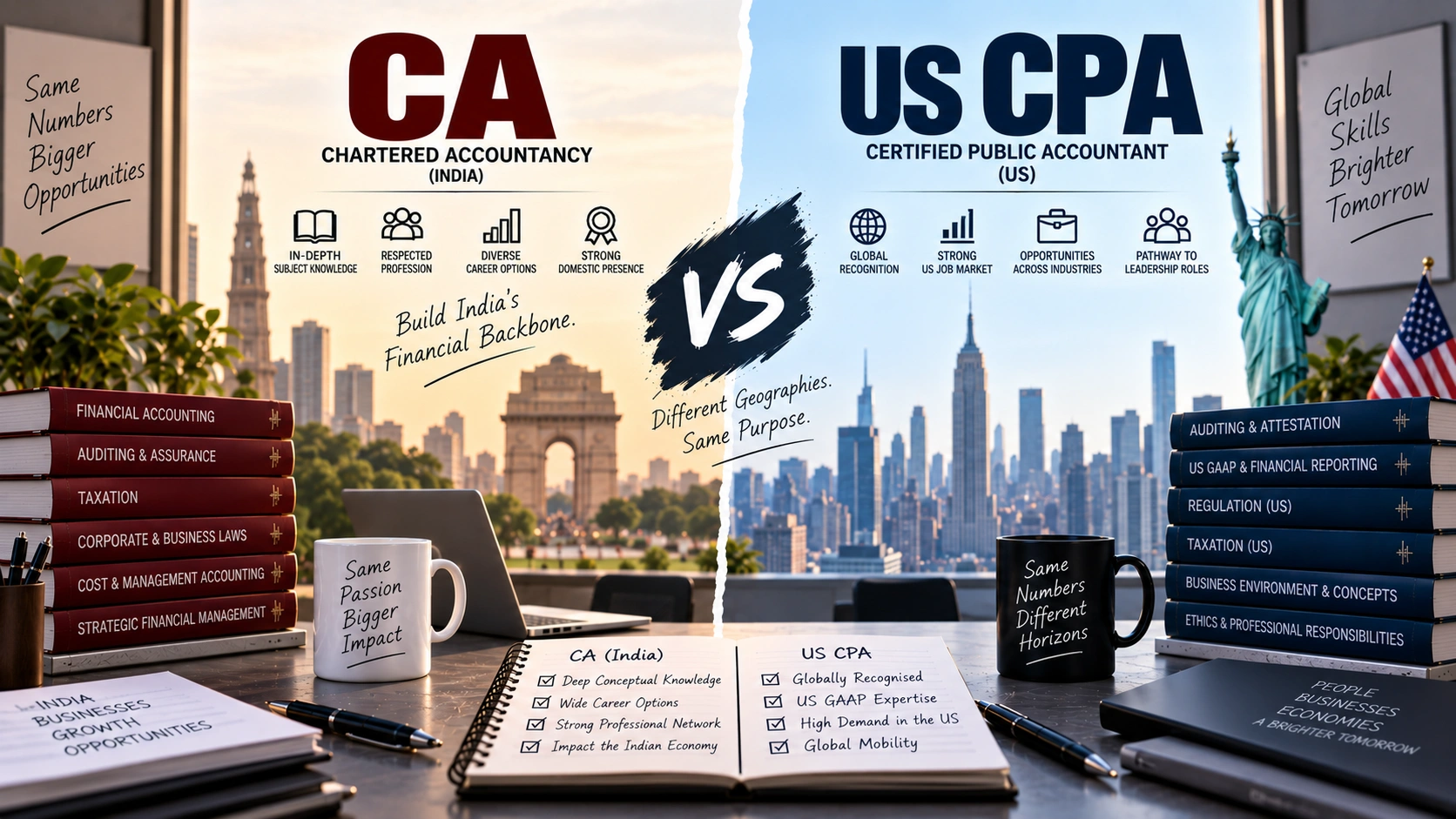
Placement season, third year of B.Com. Everyone at the chai stall is either deep into CA articleship or just found out CPA test centres now exist in India, no flights to the US needed anymore. Two people, same table, two completely different five-year plans, both convinced they picked right.
Most of what you'll find comparing these two online is written by institutes that specifically sell CPA prep, so the "verdict" tends to lean CPA before you've even reached the fee table. That's not dishonesty exactly. It's just not neutral, and a first-year student can't always tell the difference between advice and a sales pitch.
CA takes roughly 4.5 to 5 years including mandatory articleship and carries statutory audit-signing rights under Indian law. US CPA typically takes 12 to 18 months for Indian CAs, longer for non-CA candidates, and carries no signing authority in India, but is widely recognised for GCC, MNC, and US-facing roles. They're not really substitutes for each other. They solve different problems, and the comparison only gets useful once you stop asking which one is "better."
The actual numbers, side by side
| CA (ICAI) | US CPA (AICPA/NASBA) | |
|---|---|---|
| Governing body | Institute of Chartered Accountants of India | AICPA, licensed via individual US state boards through NASBA |
| Structure | Foundation, Intermediate, 3-year Articleship, Final | 4 sections (3 Core sections plus one Discipline section) |
| Typical duration | 4.5 to 5 years including articleship | 12 to 15 months for Indian CAs; 18 to 24 months for others |
| Reported total cost | Approximately Rs.1 to 2 lakh net of articleship stipend, spread over years | Approximately Rs.3.5 to 4.5 lakh all-in: NASBA evaluation, state board fees, exam section fees, international testing surcharge |
| Statutory rights in India | Only CAs can sign statutory audit reports under the Companies Act | None. A US CPA license carries no audit-signing authority under Indian law |
| Where it's valued most | Indian statutory audit, tax practice, articleship-linked industry roles, PSU and government-linked finance | GCC finance teams, Big 4 US-facing delivery centres, MNC accounting roles needing US GAAP fluency |
| Placement data point | ICAI's May to June 2024 campus placement recorded Rs.12.49 LPA average CTC and Rs.26.70 LPA highest domestic offer, across 4,782 candidates placed | No equivalent centralised Indian campus-placement dataset exists for CPA candidates |
What CA is actually for
CA exists because Indian company law specifically reserves statutory audit-signing authority for ICAI-qualified Chartered Accountants, and that single fact shapes almost the entire structure of the credential. The articleship years aren't administrative padding. They're the mechanism by which someone earns the practical judgment that eventually sits behind a legally binding signature on an audit report.
Day to day, that means three years inside a CA firm doing real client work at trainee pay, long before the Final exam is even attempted, layered on top of the Foundation and Intermediate levels that come before it. It's slow by design. Someone taking CA seriously is usually already picturing Indian statutory audit, tax practice, or an industry finance role where the CA tag itself carries specific legal and professional weight that nothing else in this comparison replicates.
The real limitation isn't difficulty, though the exam is genuinely hard. It's portability. CA's authority is Indian-specific. A CA moving into a purely US-facing or globally distributed finance role will find the credential respected as a mark of rigor, but not carrying the same automatic legal standing it has domestically. That's not a flaw. It's simply not what CA was built to do outside India's borders.
What US CPA is actually for
US CPA solves a different problem. It's built around US GAAP-based accounting, audit, and tax work, with a licensing structure run through individual US state boards rather than a single national body. For Indian candidates, especially those who've already cleared CA, the syllabus overlap in financial reporting and audit concepts genuinely shortens the runway. That's the main reason Indian CAs often clear CPA faster than candidates coming from a pure commerce-degree background.
The practical reality now looks meaningfully different from a few years ago. Prometric test centres operate in several Indian cities, so the exam itself no longer requires travel to the US the way it once did. That change alone has pulled a lot of GCC-track students toward CPA who might have skipped it purely over logistics before. Roles at Big 4 delivery centres serving US clients, or MNC finance teams running on US GAAP, are exactly where a CPA license does real, visible work.
The limitation runs opposite to CA's. No matter how quickly someone clears all four sections, a US CPA license carries zero audit-signing authority under Indian company law. It's a credential built for global and US-facing accounting work, genuinely strong at that specific thing, and structurally absent from the one context, Indian statutory audit, where CA's authority actually lives.
Where people get this decision wrong
The most visible mistake is choosing CPA purely on speed, without checking whether the target role actually needs Indian statutory authority. Someone who wants to eventually run an independent Indian audit practice, or join a firm specifically for that work, sometimes picks CPA first because 12 to 18 months sounds far more manageable than five years, only to discover the license doesn't open the door they actually wanted. CPA doesn't become a CA-equivalent just because it was faster to earn.
A quieter version of the same mistake happens with CA. Someone commits to the full five-year articleship path specifically because they're chasing a GCC or US-facing career, assuming CA is simply "the harder, more respected" credential and respect alone will translate into the specific global role they want. It often doesn't translate cleanly. GCC finance teams frequently list CPA or US GAAP fluency explicitly in job descriptions, and a CA without that specific credential can find themselves qualified in general rigor but missing the one line item recruiters are actually screening for.
The third pattern shows up in people who assume the two are more interchangeable than the data supports, largely because most of the top-ranking comparison content is written by CPA coaching businesses with an obvious commercial reason to blur the line.
The actual decision
The real question isn't which credential is objectively harder or more prestigious. It's which authority you actually need for the specific work you're picturing yourself doing in five years. If that picture involves Indian statutory audit, tax practice, or any role where a client or employer specifically needs someone with ICAI's legal signing rights, CA is the credential built for exactly that.
If instead you're picturing a GCC finance team, a Big 4 delivery centre serving US clients, or any MNC role where US GAAP fluency and a globally portable license matter more than Indian statutory authority, CPA gets you there faster and at a defined, shorter timeline. A meaningful number of people eventually do both: clearing CA first, then adding CPA once they've decided they specifically want US-facing exposure layered on top of Indian statutory grounding.
The real question isn't which is harder
It's which authority you actually need for the work you want to do. Five years buys you something CPA structurally can't replicate in India. A year-plus buys you something CA structurally doesn't optimise for.
Which one are you actually being pulled toward, the legal authority, or the faster door into a global role?""" )
print("Post 3 of 25 created: ca-vs-us-cpa.md")
Quick answers
Things people usually want to know.
Is US CPA equivalent to Indian CA?
No. They're not legally equivalent. CA carries statutory audit-signing rights in India that CPA does not have, and there's no mutual recognition agreement between ICAI and AICPA.
Which is more difficult, CA or CPA?
CA is widely considered more difficult by total effort and duration. It spans years including mandatory articleship, with CA Final pass rates historically in the 13 to 20% range. CPA is intensive but typically completed in 12 to 24 months.
Can a US CPA sign audit reports in India?
No. Only ICAI-qualified Chartered Accountants can sign statutory audit reports under Indian company law, regardless of CPA licensure.
How much faster is CPA compared to CA?
Indian CAs typically clear CPA in about 12 to 15 months due to syllabus overlap. CA itself takes roughly 4.5 to 5 years including the mandatory three-year articleship.
Do I need to travel to the US to take the CPA exam?
Not anymore. Prometric test centres now operate in several Indian cities, though international testing carries a surcharge.
Is CPA cheaper than CA overall?
By reported figures, CA often ends up cheaper net of articleship stipend, roughly Rs.1 to 2 lakh over several years, compared to CPA's roughly Rs.3.5 to 4.5 lakh over 12 to 24 months.
Can I do both CA and CPA?
Yes, and a meaningful number of professionals do, usually completing CA first, then adding CPA for roles that specifically need US GAAP exposure or GCC-facing work.
Does ICAI have any exemption arrangement with AICPA?
No formal exemption exists between ICAI and AICPA. Every CPA candidate, including already-qualified CAs, must clear all required CPA sections independently.
Which pays more, CA or CPA, in India?
It depends heavily on role and employer rather than credential alone. ICAI's own campus placement data shows meaningful average CTCs for CA graduates. CPA compensation tends to track GCC and MNC pay bands.
Is CA still worth it if CPA is faster?
If your goal involves Indian statutory work, yes. CPA cannot replace the legal authority CA carries here, no matter how quickly it's earned. If your goal is a GCC or US-facing role specifically, CPA's speed may matter more.