ACCA vs Indian CMA (ICMAI): Global Breadth vs Cost Authority
November 20, 2026 · 10 min read · by Shivam Kushwaha, Artha founder
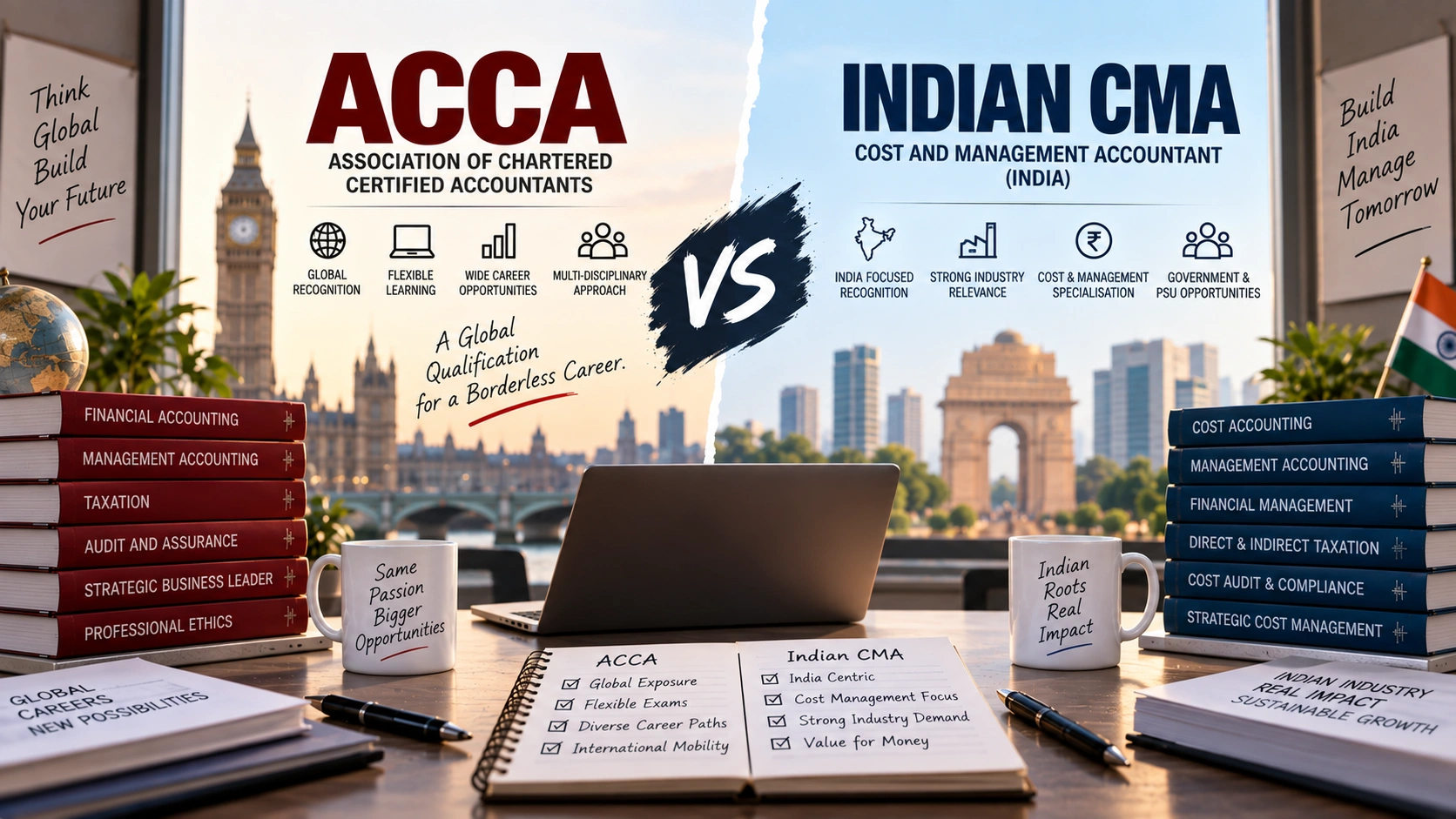
Two credentials, both with the letters CMA buried somewhere in their full names, and both claiming to open doors in accounting and finance. One is ACCA, a UK-headquartered global body with recognition across 180 countries. The other is Indian CMA, run by ICMAI, with a statutory signing right that no international credential can replicate domestically. The confusion between them is understandable, but the actual comparison is straightforward once you look at what each one authorises you to do.
ACCA is a UK-based global qualification with IFRS recognition across 180 countries and no statutory audit or cost-audit signing authority in India. Indian CMA, run by ICMAI, is an India-specific credential that grants cost-audit signing authority under the Companies Act, with a more limited international footprint. Comparing them as if one is a global version of the other misses what each credential is actually designed to do.
The actual numbers, side by side
| ACCA | Indian CMA (ICMAI) | |
|---|---|---|
| Governing body | Association of Chartered Certified Accountants (UK) | Institute of Cost Accountants of India (ICMAI) |
| Structure | 13 papers across Applied Knowledge, Applied Skills, Strategic Professional, plus Ethics and Professional Skills module | 3 levels: CMA Foundation, CMA Intermediate, CMA Final, plus 15 months practical training |
| Typical duration | 2 to 3 years depending on exemptions | 3 to 4 years including practical training |
| Global recognition | Recognised in over 180 countries; frequently listed as equivalent to local qualifications in UK, Australia, parts of the Middle East and Africa | Primarily recognised in India; limited formal equivalence overseas |
| Statutory rights in India | None. Cannot sign cost audit reports or statutory audit reports under Indian law | Cost-audit signing authority under the Companies Act, 2013 |
| Core focus | Financial reporting, audit, tax, and management accounting under IFRS and multi-jurisdictional standards | Cost accounting, cost audit, and management accounting under Indian accounting and regulatory standards |
| Where it's valued most | Big Four, MNCs, shared-service centres, roles requiring IFRS fluency across geographies | Cost audit firms, manufacturing sectors, regulatory compliance roles, and industry finance roles in India |
| Entry requirement | Open after class 12 through Foundational level; exemptions for commerce graduates | Open after class 12 through CMA Foundation; direct entry to Intermediate for commerce graduates |
| Fee range (approximate) | ₹2.5 to ₹4 lakh total including registration, exam fees, and exemption charges across all levels | ₹60,000 to ₹1,00,000 total across all levels including practical training fees |
What ACCA is actually for
ACCA was built for a specific kind of career: accounting and finance work that crosses borders. The 13-paper structure moves from foundational accounting knowledge through to strategic-level financial management, audit, and reporting, all anchored in IFRS.
The credential's real strength is in roles where international financial reporting standards and multi-jurisdictional experience matter. Big Four firms operating across countries, MNCs with consolidated reporting requirements, and shared-service centres serving global clients all value ACCA's IFRS foundation.
The real limitation is that ACCA grants zero statutory authority in India. It cannot be used to sign cost audit reports or any other statutory filing under Indian company law. Someone aiming purely at cost-audit practice in India will find that ACCA does not cover what the role actually requires.
What Indian CMA is actually for
Indian CMA exists to serve a specific legal function: the authority to sign cost audit reports under the Companies Act. The entire structure, from CMA Foundation through to CMA Final and the mandatory 15 months of practical training, is built around producing professionals who can legally execute that role.
The credential's real strength is in domestic cost-audit and cost-compliance work, particularly in manufacturing, infrastructure, and regulated industries where cost auditing is a statutory requirement. ICMAI's curriculum covers Indian cost accounting standards, the Companies Act provisions on cost records, and the practical aspects of cost-audit reporting in a way that no international credential replicates.
The real limitation is international portability. While ICMAI has agreements with several international bodies, Indian CMA as a standalone credential carries limited recognition outside India compared to qualifications like ACCA or CPA.
The MoU connection
One piece of context that often confuses people: ICMAI and ACCA have a Mutual Recognition Agreement. Qualified Indian CMAs can obtain ACCA membership by fulfilling certain requirements and passing selected papers, without starting from scratch.
This doesn't make the two credentials interchangeable. It means a qualified Indian CMA has a structured pathway to add an international credential on top of their domestic one. It's a supplement, not a replacement.
Where people get this decision wrong
The most common mistake is treating ACCA as a direct alternative to Indian CMA for cost-audit practice in India. If your goal is to sign cost audit reports under the Companies Act, ACCA cannot do that. No amount of international recognition changes that legal reality.
The reverse mistake shows up in people who commit to the full Indian CMA path without checking whether their actual career goal involves international IFRS reporting or cross-border work where ACCA's 180-country recognition carries weight.
A third pattern involves people assuming that because ACCA is international, it's automatically the "bigger" credential. In the specific context of Indian cost-audit practice, Indian CMA holds a statutory right that ACCA simply does not have.
The actual decision
The real question isn't which credential is broader or more prestigious in the abstract. It's whether your actual career goal requires a domestic statutory signing right or global IFRS portability.
If you're picturing cost-audit practice, manufacturing-sector compliance, or any role where ICMAI's specific signing authority under the Companies Act matters, Indian CMA is the credential built for exactly that, and ACCA cannot substitute for it.
If instead you're picturing multi-jurisdictional accounting work, IFRS reporting across countries, or a career that needs to be portable across 180 countries, ACCA is built specifically for that, and Indian CMA's narrower international footprint is a real limitation.
Different legal realities, not different prestige levels
ACCA and Indian CMA aren't really ranked against each other the way the search results make it look. One is a global IFRS qualification with no domestic statutory authority. The other is an India-specific credential with a signing right that no international body replicates.
Which legal and career reality do you actually want to be working inside? The answer determines which credential you need, not which one the internet thinks is better.
Quick answers
Things people usually want to know.
Which is better, ACCA or Indian CMA, for a career in India?
Neither is universally better. Indian CMA carries cost-audit signing authority under the Companies Act that ACCA does not. ACCA carries broader global recognition across 180 countries and is built around IFRS. The right choice depends on whether you need a domestic statutory signing right or global portability.
Does ACCA have any MoU with ICMAI?
Yes. ICMAI and ACCA have a Mutual Recognition Agreement that allows qualified Indian CMAs to obtain ACCA membership by meeting certain requirements and passing selected papers, without starting from scratch.
Can an ACCA member sign cost audit reports in India?
No. Only ICMAI-qualified Cost Accountants can sign cost audit reports under the Companies Act. ACCA grants no statutory signing authority in India.
How long does ACCA take compared to Indian CMA?
ACCA typically takes 2 to 3 years across 13 papers, depending on exemptions. Indian CMA takes roughly 3 to 4 years across three levels including practical training.
Is the ACCA exam harder than Indian CMA Final?
Difficulty is subjective and depends on your background. ACCA's global pass rates per paper generally range from 35 to 55 percent. Indian CMA Final pass rates have historically been lower, but the exam structure and evaluation criteria are fundamentally different.
Can I start ACCA after class 12?
Yes. ACCA allows entry after class 12 through the Foundational level, with exemptions for commerce graduates. Indian CMA also allows entry after class 12 through the CMA Foundation.
Which pays more, ACCA or Indian CMA, in India?
It depends on role, sector, and location. ACCA members in Big Four and MNC roles in metros can command strong packages. Indian CMAs in cost audit and manufacturing roles have their own earnings trajectory. No single dataset compares both directly.
Is ACCA recognised in India?
ACCA is recognised by many Indian employers, particularly multinationals, Big Four firms, and shared-service centres. It is not recognised as a substitute for Indian CMA in cost-audit signing contexts.
What kind of work does an ACCA member do that an Indian CMA doesn't?
ACCA covers financial reporting, audit, tax, and management accounting under IFRS across multiple jurisdictions. Indian CMA's curriculum is specifically built around Indian cost accounting standards and cost audit requirements.
What kind of work does an Indian CMA do that an ACCA member doesn't?
Cost audit reporting under the Companies Act is exclusive to ICMAI-qualified Cost Accountants. This is a statutory function that no international credential replicates in India.